
Pursuing Happiness - 250 Years Later: Area Members of the Sons and Daughters of the American Revolution Find Inspiration in their Patriot Ancestors
The Annual Dinner of the Jackson County Historical Society - “A Patriotic Celebration of History” - is scheduled Friday, March 27, at the Midwest Genealogy Center auditorium at 3440 S. Lee’s Summit Road in Independence.
To find information about tickets, go to jchs.org/annualdinner
The deadline to order is March 19.
This month’s E-Journal is an updated version of a recent story posted on https://flatlandkc.org in advance of the Ken Burns documentary, “The American Revolution.”
BY BRIAN BURNES
It was 10 p.m. last Veterans Day when the returning service members stepped onto the terrazzo surface between Baggage Carousels 5 and 6.
The veterans, many from the Vietnam War era, were returning to Kansas City International on the return leg of their Honor Flight, the nonprofit that takes veterans on free, day-long visits to Washington, D.C.
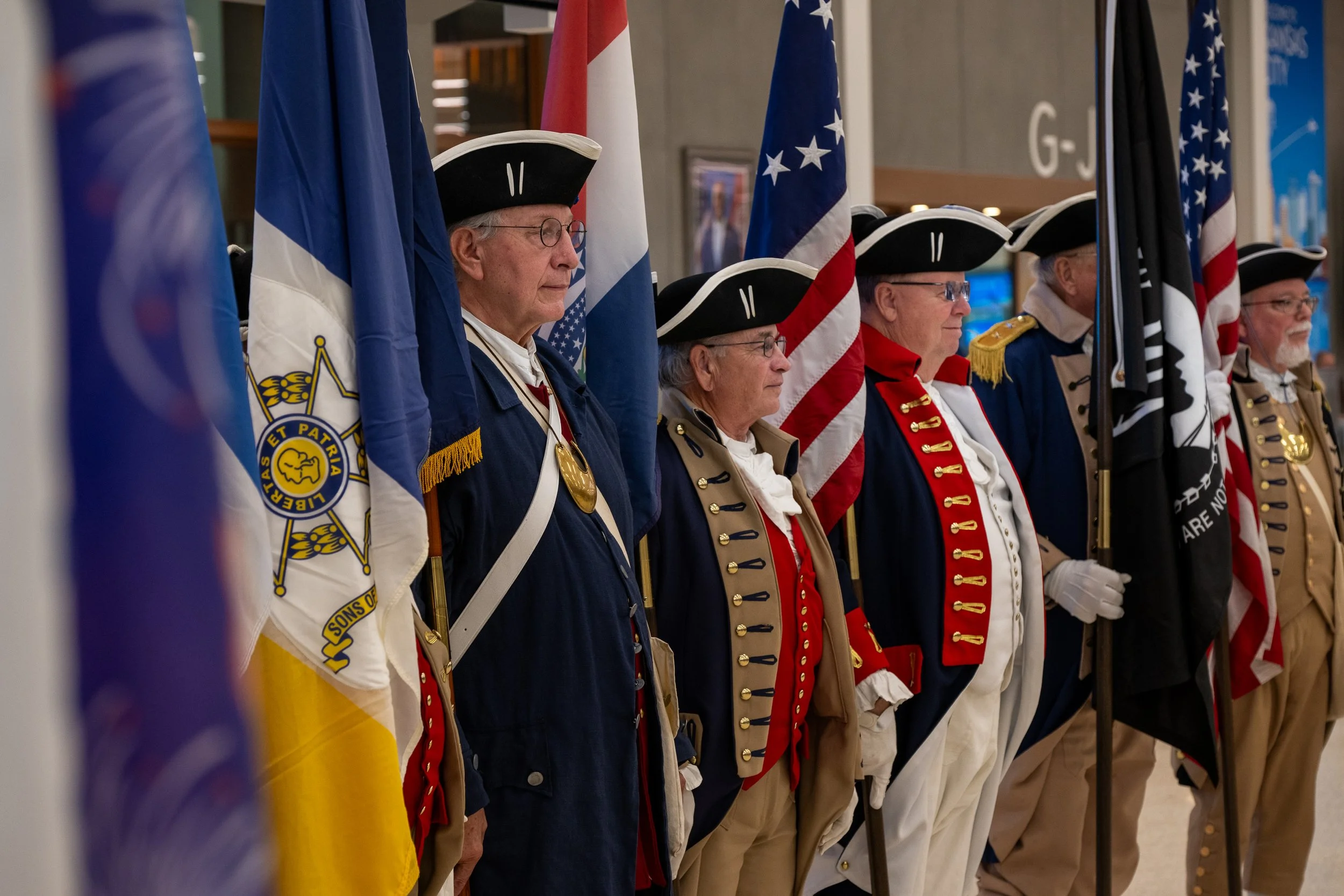
Last Veterans Day, several Kansas City area members of the Sons of the American Revolution welcomed home veterans returning from an Honor Flight to Washington, D.C. Photo courtesy of Todd Feeback.
Waiting for them stood 12 area members of the Sons of the American Revolution.
Turned out in tri-corner hats, knickers and buckled shoes, they called out “Welcome home” to each veteran.
Among those vets whose eyes grew watery was Russell Hannah of Harrisonville, who returned home from Vietnam in 1970.
“When we came home then, we were cussed at and spit on,” Hannah said.
“But this was beautiful.”
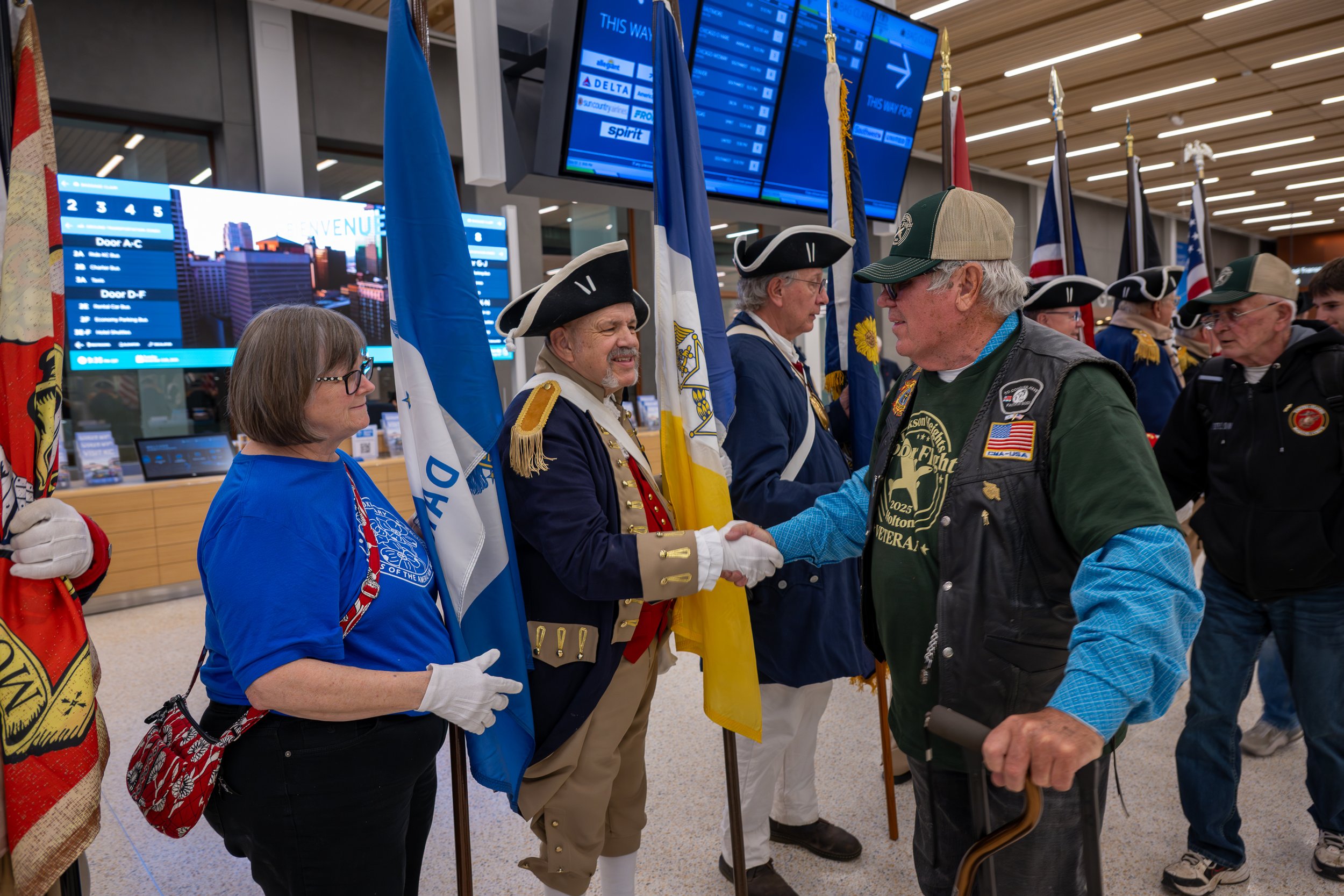
Among those veterans greeted at KCI last November was Russell Hannah of Harrisonville, shown here accepting a handshake from Ivan Stull of the SAR Harry S. Truman Chapter, which includes many eastern Jackson County members. Photo courtesy of Todd Feeback.
Among the SAR members was Darrell Jones, a retired Smithville minister portraying a colonial clergyman.
“It’s almost like the Founding Fathers are here to welcome these veterans home,” said Jones, adding that the emotions prompted by their presence cannot be disguised.
“You can see it in their countenances,” he said
For Jones and his fellow SAR members, such small ceremonies represent those authentic moments when abstract concepts like “freedom” and “liberty” become visible in everyday life.
This year marks the 250th anniversary of the signing of the Declaration of Independence. Among the unknown number of celebrations across the country will be the Friday, March 27 Annual Dinner of the Jackson County Historical Society at the Midwest Genealogy Center, 3440 S. Lee’s Summit Road, in Independence.
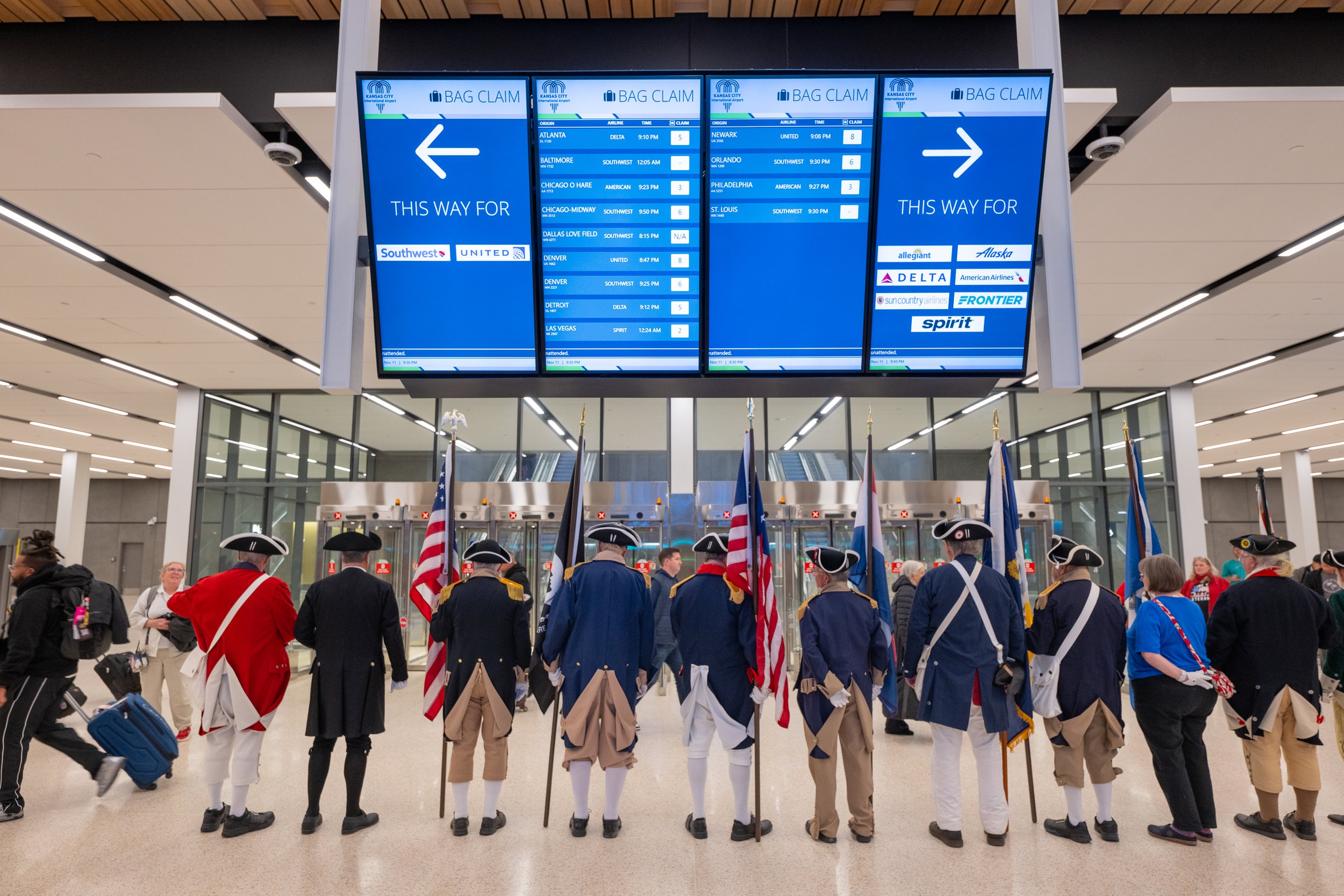
Kansas City area SAR members often can be spotted at Kansas City International Airport, as they enjoy welcoming home veterans returning from Honor Flights. The flights are organized by local chapters of the national nonprofit which promotes one-day visits to Washington, D.C. at no cost to veterans. Photo courtesy of Todd Feeback.
The dinner’s patriotic theme will include a color guard presented by members of two area SAR chapters.
The national SAR, as well as the separate Daughters of the American Revolution, are lineage societies. Members qualify when they can document among their ancestors a “patriot” who served In the Continental Army or assisted in the triumph over British tyranny.
SAR chapter members often organize color guards.
Members of the DAR, meanwhile, commit to service projects.
Last year members of DAR Westport Chapter - on the society’s annual “Day of Service” - prepared care packages at Heroes Home Gate, a Kansas City transitional living program which provides short-term housing and other support services for veterans.
The revolution’s 250th anniversary is being observed in a divisive time often characterized by charged rhetoric involving the future of democracy.
Members of Kansas City area Sons and Daughters chapters say they remain focused on honoring Revolutionary War patriots.
“The Daughters of the American Revolution is a specifically nonpartisan and nonpolitical service organization,” added Julia Jackson, regent of the DAR’s Westport Chapter in Kansas City.
“We have nearly 190,000 members in 3,000 chapters across the world, and while I’m sure there is a full breadth of personal viewpoints among our members, the discussion of politics is explicitly prohibited.”
Approximately 217,000 individual service members served in the American Revolutionary War between 1775 and 1783, according to the Department of Veterans Affairs.
Of the 577 patriots interred in Missouri, the graves of 27 - bearing names such as Isaac, Jeremiah, Ledstone and Nathaniel - can be found in the Kansas City area, according to a database compiled by a Missouri SAR member.
There is one Elizabeth.
And, in Kansas, there is a Sarah, honored in 2019 by Kansas SAR members.
It’s not known that either Sarah Ruddell Davis or Elizabeth Duncan Porter ever shouldered a musket in combat.
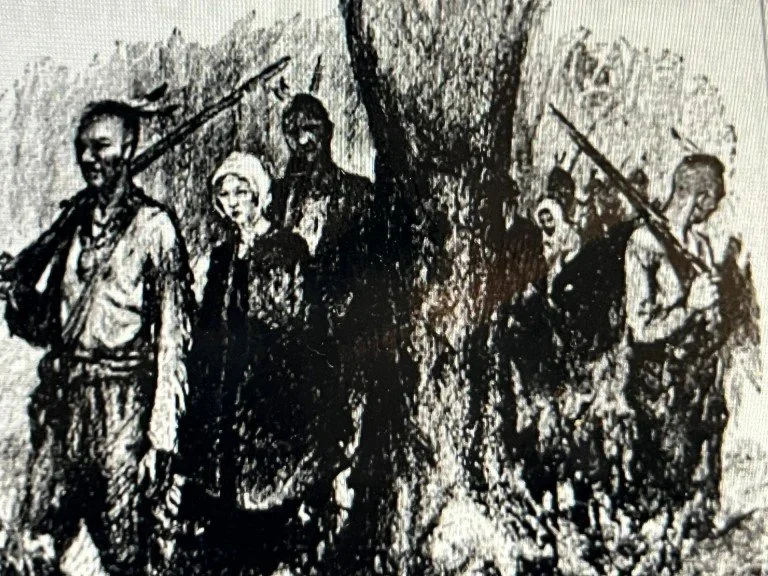
The capture of patriot Elizabeth Duncan Porter and the forced march that followed was depicted in this 1931 illustration by a Kansas City Star artist. Courtesy of The Kansas City Star.
Both, however, were taken prisoner by the British and the Native American tribe members allied with them, forced to march hundreds of miles to their places of captivity, and held for several years.
Upon her release, Sarah married Thomas Davis, another prisoner, and with him came to Missouri.
Upon her husband’s 1837 death, Davis moved to Kansas to live near a daughter, Sarah T. Johnson, wife of the Thomas Johnson, operator of the Shawnee Indian Mission and the namesake of Johnson County.
She died in 1865 and today her grave can be found in a small cemetery adjacent to Shawnee Mission Parkway in Fairway.
Last April Missouri SAR chapters gathered at Kansas City’s Union Cemetery to honor Porter, who died in Jackson County in 1845. DAR members had commemorated her gravesite in 2008.
The ceremonies were timely. In 2020, the DAR launched the E Pluribus Unum Educational Initiative to increase awareness of women, as well as African Americans, Native Americans and those of mixed heritage who played roles in the revolution, said Jackson.
Those who visit the initiative website https://honoringourpatriots.dar.org/e-pluribus-unum-main/ can find thumbnail descriptions of individuals whose patriotic actions often are detailed alongside supporting documents and sometimes reproductions of 19th oil-on-canvas paintings.
William Lee, an enslaved person who served as personal valet to George Washington, is thought to be the person of color visible in the background of a 1780 portrait of Washington by artist John Trumbull.
“The DAR is committed to telling the stories of those patriots who have been left out of the pages of history,” Jackson said.
Jackson has proved her connection to three patriots, among them James Woods, commissioned a Continental Army colonel in November, 1776, four months after the Declaration was signed.
“I like to believe that if we know the names of these patriots and learn their stories, they are not entirely forgotten,” Jackson said.
Tracking down the patriots
Area SAR members, among them Jack Quint of Kansas City’s Alexander Majors chapter, feel the same.
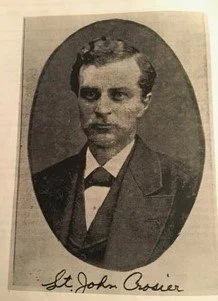
This portrait of patriot John Crosier appeared in “The Family History of Lieutenant John Crosier and His Descendants, 1750-1995,” published in 1995. Photo courtesy of Jack Quint.
When Quint’s fourth great grandfather John Crosier was married on April 13, 1775 to his wife, Fannie Whiting, John Crosier was a 25-year-old farmer in the agricultural district of Dorchester, Mass., just south of Boston.
But within days he was a midnight rider, warning neighbors of approaching British troops.
“He was fighting the British on his honeymoon,” Quint said.
Crosier was present at the battles of Lexington on April 19 and Bunker Hill on June 17.
On December 26, 1776 - the night George Washington’s troops famously crossed the Delaware River - he was assigned to an artillery battery stationed to prevent the retreat of Hessions, the German troops hired by the British to help suppress the colonial resistance.
Crosier endured the Continental Army’s winter 1777-1778 encampment at Valley Forge and went on to serve in other engagements, among them the Battle of Yorktown, which ended in the British surrender in October, 1781.
Crosier eventually earned the rank of second lieutenant.
“Our family records show that as an officer, he gave farewell to his commander-in-chief, George Washington,” Quint said.
The exact details of where this occurred and whether Crosier’s formal “farewell” included a personal handshake with or salute to Washington is lost to time.
Crosier then returned to Massachusetts where he and Fannie reared 11 children.
Quint gathered this information from family histories, as well as DAR member Sandra Scott, wife of fellow Alexander Majors chapter James Scott, and staff librarians at the Midwest Genealogy Center in Independence.
“We may be out here in the Midwest but we are linked to what happened 250 years ago,” Quint said
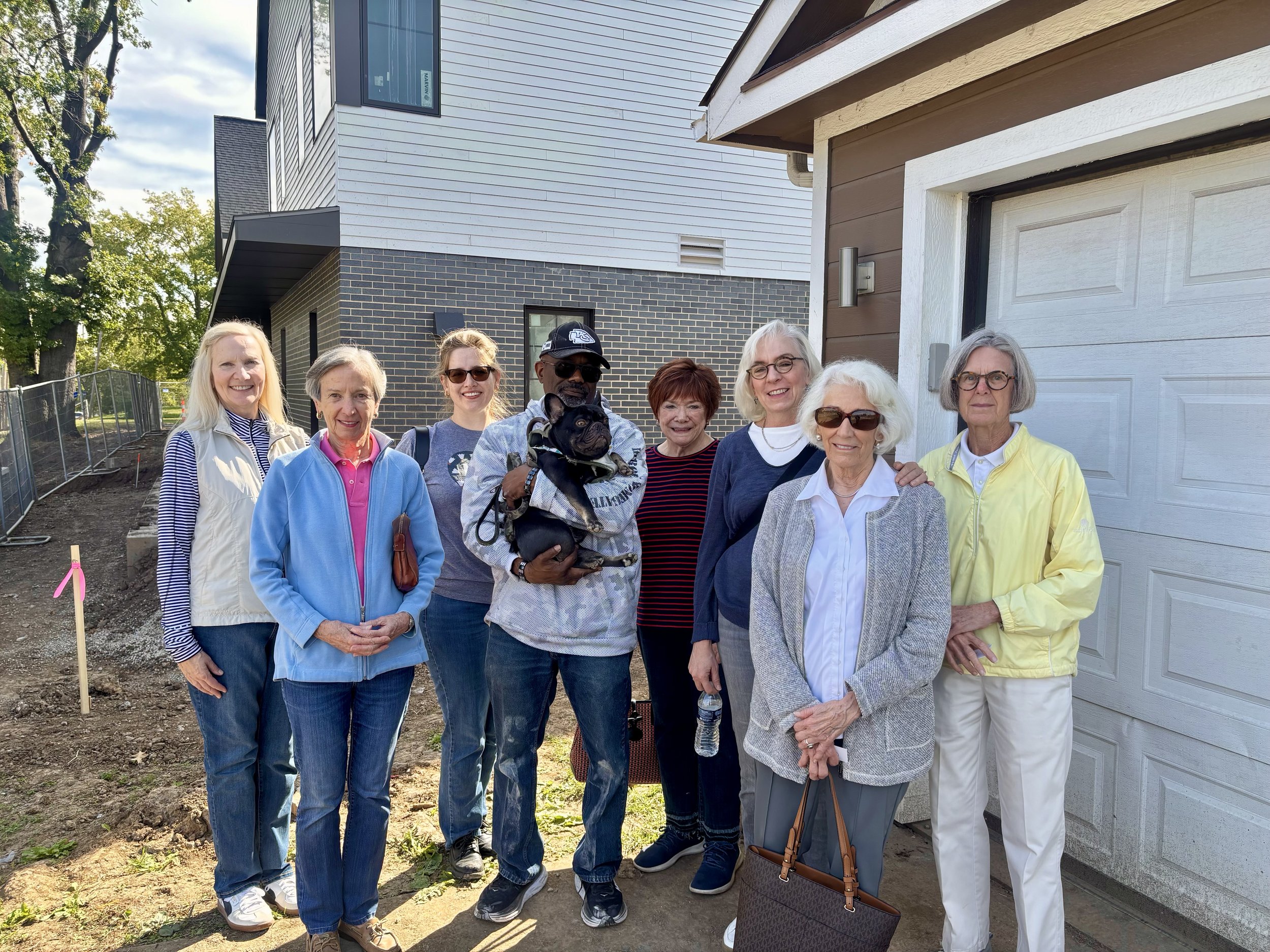
Last October members of the Daughters of American Revolution Westport Chapter prepared care packages for veterans at Heroes Home Gate, a Kansas City transitional living program which provides short-term housing and other support services. Photo courtesy of the Westport Chapter, Daughters of the American Revolution.
All this might be remarkable enough but John Crosier’s Revolutionary War service, Quint said, takes on added poignance for him when contemplated in context of his father, Jack Kenneth Quint, a World War II veteran. As a member of the 783rd Bomb Group in the Army Air Corps during the Rome-Arno and Southern France campaigns, the elder Quint survived 25 combat missions as an aerial gunner on the B-24 Heavy Bomber, earning two Bronze Stars.
“It’s a deeply personal experience to reflect on my father and my fourth great grandfather and the sacrifices they made when the nation needed them,” said Quint, whose full name is Jack Kenneth Quint II.
Ivan Stull of the Harry S. Truman chapter has documented two patriots among his ancestors. But he has been stymied in his attempts to document his connection to Laban Landon.
George Washington selected Landon, then serving in a New Jersey regiment, to serve as his bodyguard.
There is, however, a break in the documentation between Stull’s third and fourth great-grandparents.
“I have yet to find that piece of paper,” Stull said.
But he continues to look, and why not, considering the stories handed down about Landon?
“Washington looked him in the eye and said, ‘How about you?’ ’’ Stull said. “That’s a close connection to Washington, and he was my fifth great-grandfather.”
Missouri gets the news
The westernmost major battle of the Revolutionary War took place in Missouri.
The British lost.
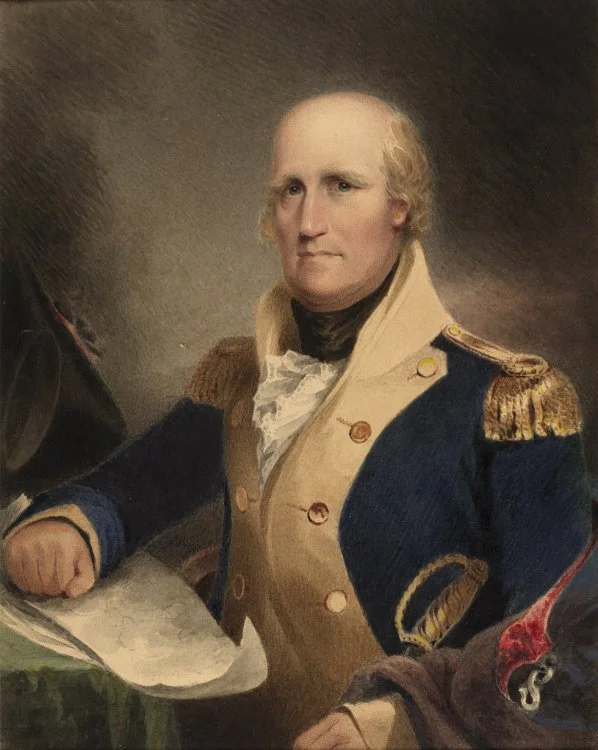
Eastern Missouri residents didn’t learn of the Declaration of Independence until the 1778 arrival of George Rogers Clark, a frontier military leader. Image is public domain.
The 1780 defeat of British troops and members of several Native American tribes by Spanish troops affected nothing immediately in what is now Kansas City.
But the engagement between forces representing the empires then struggling for control of the American West - followed by the British surrender in 1781 - influenced the decision of the French fur-trading Chouteau family to establish in the early 1820s an outpost near the confluence of the Missouri and Kansas rivers that would become Kansas City.
News of the Declaration had taken time to get around.
Residents of St. Louis didn’t learn of the Declaration until the 1778 arrival of George Rogers Clark, a frontier military leader who, acting on directions from Virginia governor Patrick Henry, captured the British outpost in Kaskaskia in what is now Illinois.
Ongoing hostilities disrupted trade and in 1779 Auguste Chouteau, the fur-trading family’s patriarch, headed south to New Orleans to secure trade goods.
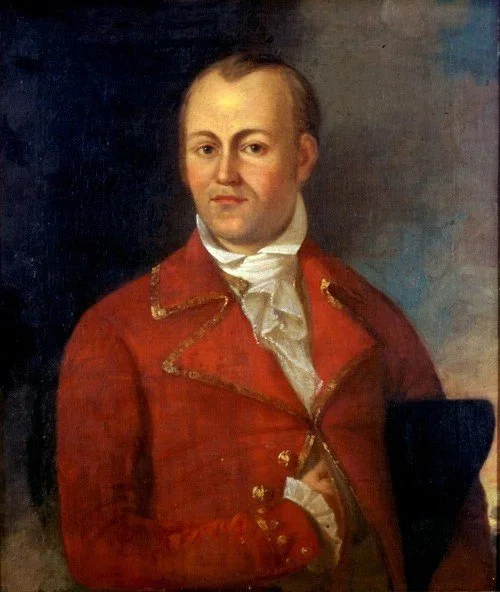
Auguste Chouteau, patriarch of the fur-trading Chouteau family, helped Spanish forces defeat British troops in the 1780 Battle of St. Louis, the furthest-west engagement in the American Revolutionary War. Photo courtesy of the Missouri History Museum.
“When he got there, he found out that Spain, which then was controlling the upper Louisiana area, which included St. Louis, had just declared war on Britain,” said William E. Foley, University of Central Missouri history professor emeritus.
The Chouteaus prospered for decades after the British surrender, expanding their fur-trading empire.
In 1821, Francois Chouteau, a nephew of Auguste, with his wife Berenice, established a trading post near where the Missouri and Kansas rivers met.
The family’s influence, Foley said, “continued unabated under the aegis of the United States and was instrumental in the subsequent founding of Kansas City.”
Promises unkept
An estimated 15,000 African Americans fought with the British, responding to promises made to them, said George Pettigrew of Kansas City, chair of the Frontier Museum of the U.S. Army Foundation, now partnering with the Army to establish a new museum at Fort Leavenworth, Kan.
“The British said, ‘We will give you your freedom, we will pay you, and we will relocate you out of this country if you wish,’ “ Pettigrew said.
“The patriots didn’t promise that.”
Such assurances were rendered moot by the 1781 British surrender. In the 1783 Treaty of Paris the British agreed to return property taken from the colonials, Pettigrew said.
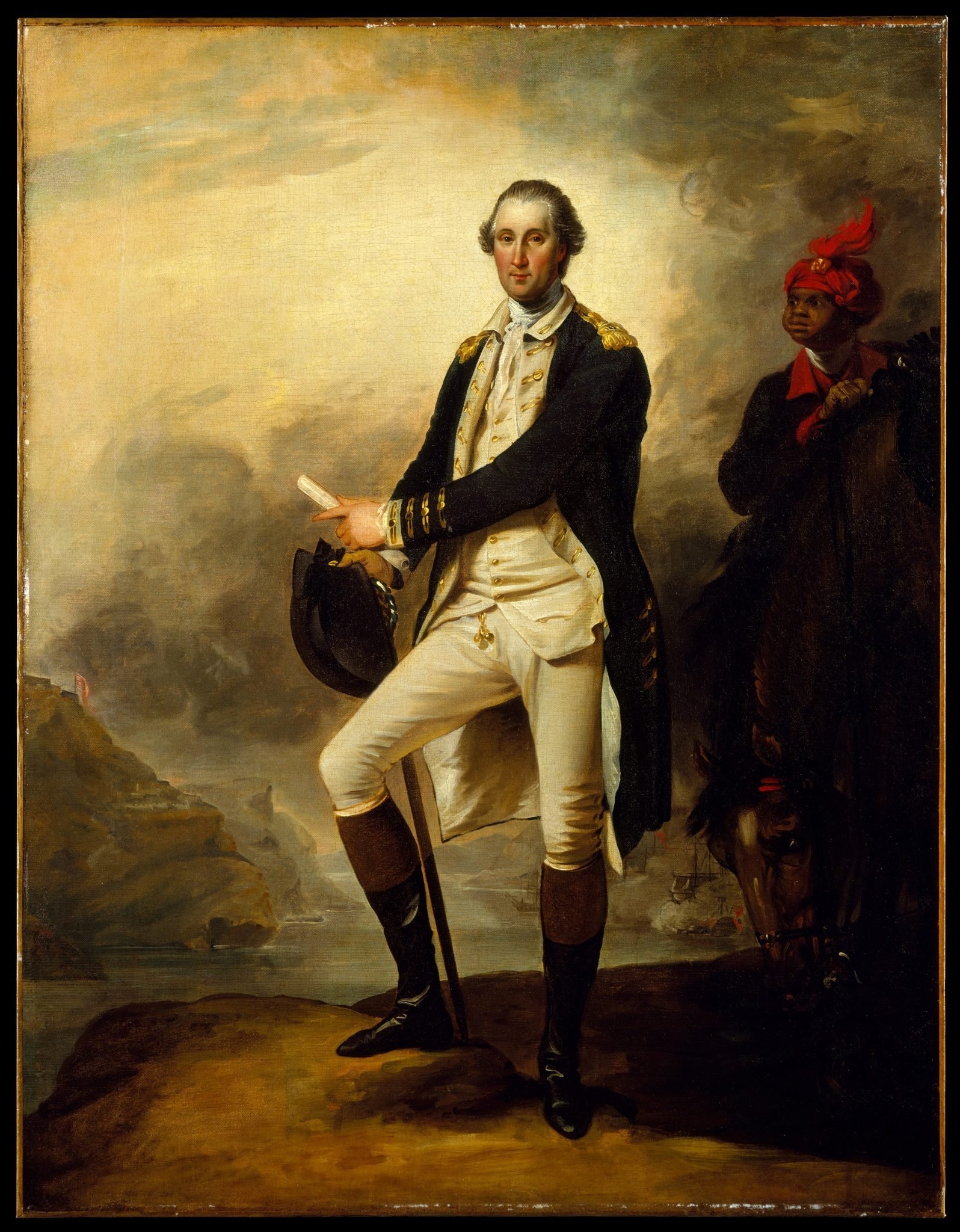
The person of color seen to the right in the 1780 painting “George Washington” by artist John Trumbull often is thought be a depiction of William Lee, Washington’s enslaved valet. Image is public domain.
“That property included people.”
It’s only been in recent memory, he added, that many now believe a person of color can be seen handling an oar just to the right of George Washington in the familiar painting “Washington Crossing the Delaware,” rendered by artist Emanuel Leutze in 1851.
“There have been lots of stories we have chosen to ignore if they don’t fit that narrative that has been part of America for so long - that African Americans don’t have value, we are not worthy, we are not capable,” Pettigrew said.
In 1852 orator and abolitionist Frederick Douglass delivered an Independence Day address that articulated how the promises of freedom made during the Revolution remained unfulfilled for African Americans.
“The Fourth of July is yours, not mine,” Douglass said in Rochester, N.Y. “You may rejoice, I must mourn.”
Neither victims nor bystanders
Last November, the Public Broadcasting Service presented the 12-hour Ken Burns documentary “American Revolution.”
The New York Times declared the “centrality” of Native Americans during the war was the documentary’s most “eye-opening” aspect.
“They are presented not as victims or bystanders, but as members of powerful nations faced with complex choices about how to defend their own liberty,” the Times announced.
The Native American legacy from the Revolutionary War is complicated, said Angela Montgomery of Shawnee, a Citizen Potawatomi Nation member.
Last summer, as a member of a Johnson County Parks and Recreation public art selection committee, Montgomery helped dedicate the “Fire Keepers Circle” in Heritage Park in Olathe. The sculpture marked the spot that some 800 Potawatomi tribe members reached near the end of the “Trail of Death” march of 1838. An estimated 42 Potawatomi died during the 660-mile slog from Indiana.
Among the several small monuments marking that trail through Jackson County is one placed just north of the Roger T. Serman Center, southeast of the intersection of Nolan and Truman roads.
Some factions of the Potawatomi tribe had entered into an alliance with the British during the Revolutionary War.
“It was tricky, with a lot of moving parts,” said Montgomery of the options the Potawatomi faced.
“They were trying to make the best choices they could.”
After the British surrender in 1781, the federal government often proved hostile to Potawatomi interests. In 1830 President Andrew Jackson - who as a teenager had been taken prisoner by the British - signed the 1830 Indian Removal Act.
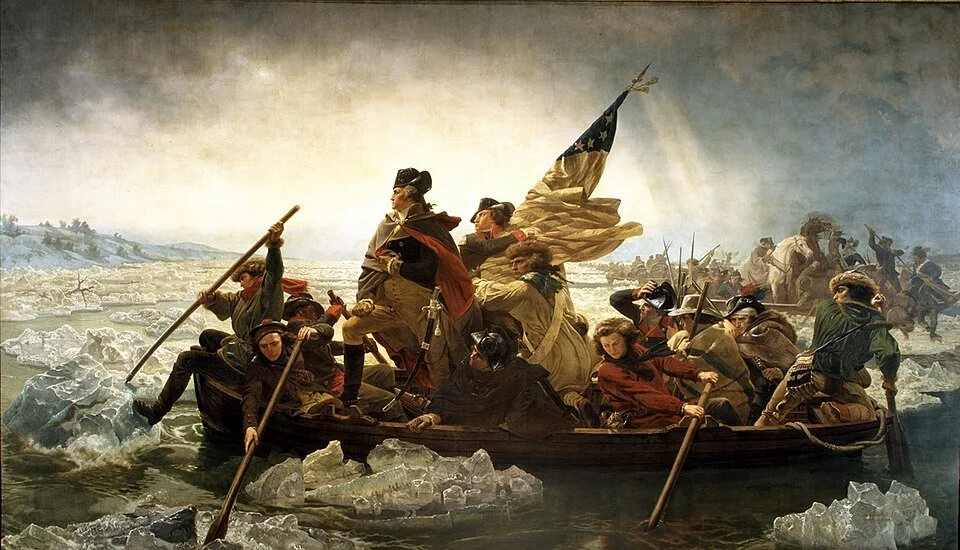
The 1851 painting “Washington Crossing the Delaware” by artist Emanuel Leutze depicts, according to some scholars, a person of color handling an oar just to the right of George Washington. Image is public domain.
“This was a plan to eliminate the Indians both physically and spiritually,” said Montgomery, who in 2023 traveled the Trail of Death’s path.
“There was never a plan to live among the Indians - just a plan to get them out of the way or assimilate them, so they would behave and live in a more colonized manner.”
The observances begin
At 1 p.m. Wednesday, March 25, members of the Harry S. Truman SAR Chapter are scheduled to host the third annual “Above & Beyond” Medal of Honor Day at the Truman Presidential Library and Museum in Independence.
Past ceremonies have saluted Medal of Honor recipients from World War II, as well as from the Korean and Vietnam wars, who were also SAR members. This year, for the first time, the chapter will honor three Medal of Honor recipients who were not SAR members.
Among them is Vernon Joseph Baker, the first living African American to be so honored, who received the Medal of Honor from President Bill Clinton in 1997.
At 5 p.m., Wednesday, July 8, the SAR Alexander Majors chapter will host a Truman Library reading of the Declaration of Independence as part of the “Sharing the Spirit of America.” The event will be part of a nationwide initiative promoting a simultaneous nationwide reading of the Declaration to mark the document’s first public reading on July 8 1776.
Also, this summer, the DAR Westport Chapter will install an “America 250!” Historic marker in Kansas City’s Union Cemetery. The dedication will be part of a nationwide DAR effort to dedicate plaques across the country that will honor both men and women patriots for their actions during the Revolution.
Although the dedication has yet to be scheduled, the historic marker has been ordered, according to Julia Jackson, DAR Westport Chapter regent.

Brian Burnes is the former President of the Jackson County Historical Society.