
Talks With A Brogue, Acquainted With Every Rogue: The Rise of Johnny O’Neill, the “Brains” Behind the Early Pendergast Machine
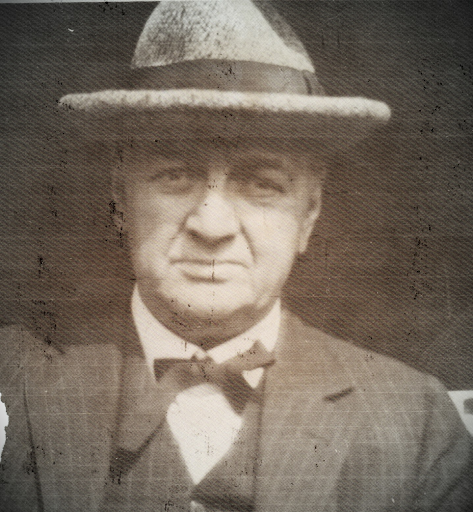
John O’Neill
Pat O’Neill knows Kansas City’s Irish history.
For years, O’Neill, a retired Kansas City marketing and public relations professional, has served as the community’s convener of the clans, co-founding the annual Kansas City Irish Fest and presiding as a former president of the Kansas City Irish Center.
He also has served as chronicler of the area’s Irish community, publishing several books that have increased the larger community’s awareness of the local Irish. In 2000, O’Neil published “From the Bottom Up: The Story of the Irish in Kansas City,” and added more details to that story with an updated version in 2015.
And now, with a new book, O’Neill has narrowed his focus to examine the role his own family played in that story.
In “The O’Neill Family in America: Would-Be Saints and Sometimes Sinners,” O’Neill tells the story of his great-grandfather, John P. O’Neill, who found a foothold in the growing political organization of “Big” Jim Pendergast, the St. Joseph, Mo. native who by the 1880s had begun organizing the meatpacking and stockyard employees of the Kansas City’s West Bottoms district into a distinct voting block.
In 1892, those workers elected Pendergast to represent the First Ward on Kansas City’s Board of Aldermen.
O’Neill, the operator of two Kansas City shoe stores, came to know and assist both Jim Pendergast and his younger brother Tom, and he soon would have his own seat on the board.
Over time, O’Neill became known as the “Bell Goat” of the Pendergast machine.
The word “Goat” referred to the name at one point given to the West Bottoms supporters of the Democratic Party Pendergast faction, as some of them lived in shacks on the district’s high bluffs and apparently were fond of keeping goats.
And the “Bell Goat” term was apt, O’Neill came to be recognized as the Pendergast machine’s chief lieutenant and spokesperson for the “Goat” faction.
BY PAT O’NEILL
“Political fictionists might well turn to John P. O’Neill for a character. For, in his directorship of the city council, his rule over Democratic city conventions, and his domination of the city planning commission, ‘Johnny’ O’Neill stood apart in picturesque colorfulness.”
Kansas City Post, Dec. 13, 1922
Embarking from a coal-huffing midday train in the spring of 1882, young John P. O’Neill was no doubt gobsmacked by the sights he saw and the things he smelled in “West Kansas,” now known as Kansas City’s West Bottoms. Across the street from the new Union Depot (which was so elaborate and expensive for its time, the locals were calling it “The Jackson County Insane Asylum”) was a seemingly endless line of saloons, honky-tonks, gambling dens, and flophouses.
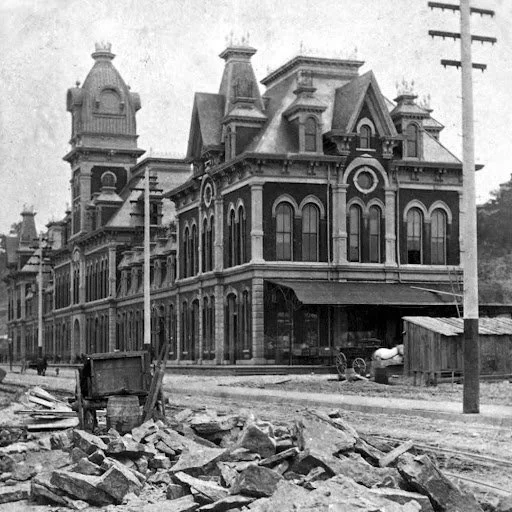
Born to Irish immigrant parents in the coalfields of western Pennsylvania in 1862, John Patrick O’Neill came to Kansas City looking for opportunities that didn’t require wearing a headlamp or swinging a pickaxe in the dark.
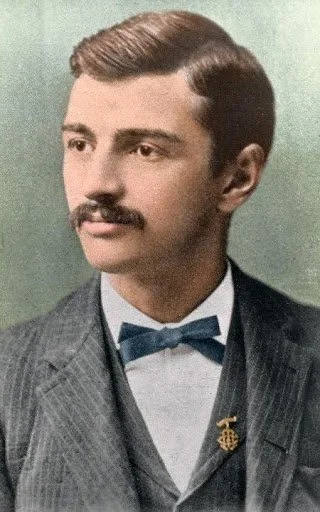
John Patrick O’Neill.
Around the depot danced a carnival of debauchery that went on 24 hours a day – bawdy houses, open and wholesale gambling, including bunco, floating craps tables, roulette, and shell games. Painted madams and their soiled doves called from alleys and second-floor windows.
Brash hustlers hollered at every greenhorn, and the noise from rowdy revelers and out-of-tune pianos leaked out of the saloons. Just outside the depot, Union Avenue carried an endless parade of horse-pulled buggies, carriages, and work wagons, along with cowboys on horseback riding under canopies of dust.
Irish workmen passing by on the wooden sidewalks would walk with shoulders back and a cocky gait that town gentry jokingly referred to as “the Kerry Patch stride.” (Note: “Kerry Patch” referred to the hundreds of Irish- inhabited shanties surrounding Father William Dalton’s original wood-frame Annunciation Church in the West Bottoms.)
Like other young, hopeful Irish fellows escaping the coal fields of Pennsylvania or the newly carved subway tunnels of New York, John P. O’Neill was likely mesmerized by the vibrancy and growth of Kansas City. Never mind the ongoing debauchery and constant clang of passing “paddy wagons.”
In the 1880s, Kansas City was undergoing what historian Clifford Naysmith called “a period of fantastic and feverish growth.” Between 1880 and 1890, the population would more than double, from 55,000 to 130,000. Forty new neighborhood additions were platted and real estate prices skyrocketed. The word was out that there was a job for every man who wanted work.
On the flip side, in 1883, alone, KC police arrested 4,064 people for misdemeanor acts, 2,273 for public intoxication, 22 lewd women for riding in open hacks, four for handing out indecent business cards, and several dozen women and saloonkeepers for throwing slops in gutters.
The smells of piss and manure from the nearby stock pens and blood and guts from Swift’s and Armour’s cattle-butchering abattoirs would have made any newcomer gag, if not choke.
Water from the Kaw was nasty and not fit to drink. As one character of the day said, “It made whiskey drinking a virtue.”
The nicely appointed Blossom House Hotel and the elegant European furnishings in some of the better gambling houses and brothels around the depot belied the grotesque scenes playing out round-the-clock in the nearby packing houses that were belching noxious fumes into the sky and sending tons of slippery, gelatinous offal into the Kaw River.
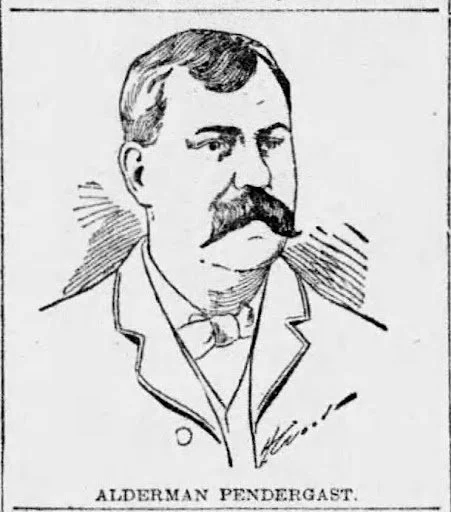
The burly, gregarious business owner with the walrus mustache evidently took a liking to young O’Neill, as their meeting would lead to more than 30 years of friendship and two lifetimes of rough and tumble, go-for-it-all politics that would change the image and likeness of Kansas City.
Not long before O’Neill came to Kansas City looking for opportunities, another young son of Irish immigrants named Jim Pendergast had arrived, looking for the same.
After working for a time in one of the Dickensian West Bottoms packing houses and as a “cupola tender” – the operator of a vertical furnace for melting iron – making $1.75 a day in a primitive iron works, “Big Jim” had just opened his own business, a boarding establishment called “The American House,” when 20-year-old John P. O’Neill came looking for a place to bunk until he could find a steady job.
O’Neill soon found work as a lowly clerk in a shoe store at Fourth and Main, adjacent to the Old Market, and found a room to rent “uptown” at 616 Locust.
Politics: The Way Up From the Bottom
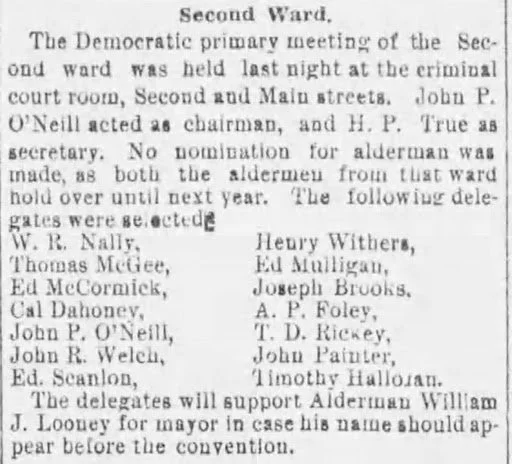
Kansas City Journal, March 25, 1887
“Kansas City’s Irish were drawing the same lesson from the experience that Irishmen in older towns had already learned – namely that political powers would confound their enemies.” From “At the River’s Bend: An Illustrated History of Kansas City, Independence and Jackson County,” published in 1982, by Sherry Lamb Schirmer.
In short order Pendergast, O’Neill, and a new pal, the future insurance magnate Tommy McGee, who was working as a lowly hotel clerk, became dues-paying members of Kansas City’s Irish American Democratic Club, helping to decide which Irishmen they would put up against the established Protestant gentry for local offices.
Within a few years, O’Neill quit his job selling shoes for another man and opened the first of two shoe stores of his own.
In 1891, with a push from the West Bottoms’ best-known and favorite son, Jim Pendergast, O’Neill was appointed to the Kansas City Board of Parks Commissioners.
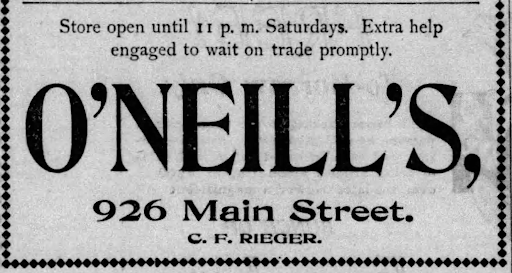
That first parks board, which included Mayor Benjamin Holmes, was eventually declared unconstitutional due to the way its charter was written, and a new “first” Board of Parks Commissioners was appointed in 1892.
That same year, O’Neill’s influential pal, “Big Jim,” put him up as a Democratic candidate for the elected office of Jackson County sheriff, in those years, a largely administrative position.
The Kansas City Times pushed O’Neill’s candidacy, saying: “It ought to be the party’s especial charge to encourage its capable young men. The election of John P. O’Neill would do as much to give permanent strength to the party as that of any other man on the county ticket.”
And O’Neill won his first term as sheriff of Jackson County.
In the city elections that year, Pendergast won his first of many two-year terms as alderman from the First Ward, which included all of the West Bottoms on the Missouri side.
Quick Cries of Voter Fraud
When the results of the 1892 county election were announced, the Kansas City Journal and John P.’s Republican opponent quickly screamed “foul” and claimed, to deaf ears, that the winning Democrats were part of “an unscrupulous a gang as ever gained their ends by glaring and unblushing fraud.”
Sheriff O’Neill was re-elected in 1894. But again, shouts of fraud and ballot-box stuffing were raised. The Kansas City Journal claimed, “O’Neill was beaten by a majority of 840, but owing to the fraudulent work of the gangsters, he was given the office.”
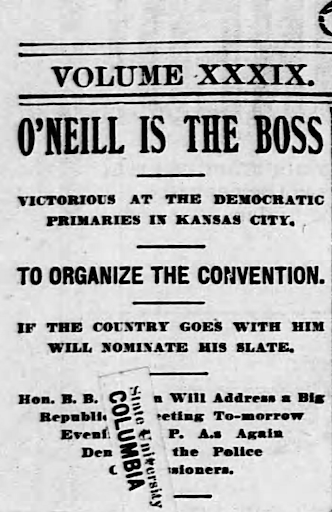
Kansas City Journal, Aug. 30, 1896
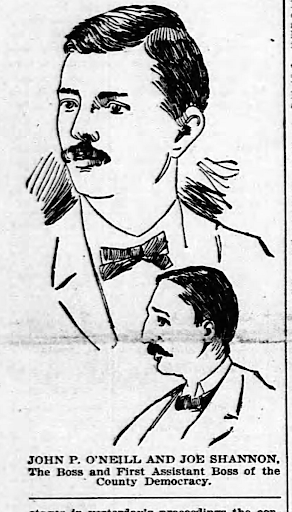
Despite frequent claims of vote fraud and loud complaints of cronyism. O’Neill was re-elected in 1894, and by 1896 the press often referred to him as “CHIEF BOSS OF THE GANG.”
Amidst all the nasty accusations of ballot-box stuffing, voter-list padding, and cronyism from the Journal and the Star came a few kind words about “the new chief boss.” Publisher Charles O’Malley of the small Kansas City World newspaper printed a profile of J.P. O’Neill in September of 1897 that painted a kinder picture: “Mr. O’Neill has shown his public spirit in taking an active interest in local politics. He continues to take a very active interest in politics, and is known as the wheel-horse of his party. Mr. O’Neill is a dyed-in-the-wool Democrat. No man wields a wider influence in the county and district.”
But the turning point in what was to be a long political career for O’Neill came in 1898 at the city Democratic convention, when Pendergast and O’Neill consummated their political marriage.
Excerpted from Kansas City Star Editorial, June 28, 1898
JIM PENDERGAST GRABS FOR POWER
“Alderman James Pendergast is the new boss. He has gathered around him some of the shrewdest and most powerful politicians from other factions. In that convention was formed the new combination of Pendergast, (James A.) Reed and O’Neill. O’Neill is the thinker and schemer of this combination. O’Neill designs and Pendergast executes.”
Back to the Bottom…
Just when it seemed John P. O’Neill had reached a pinnacle in his career as a Democratic boss, there is evidence that, after losing his young wife to consumption and seeing his shoe business going downhill, he slipped into a long period of lonesomeness, with whiskey as his roommate.
Between the time he left office as sheriff of Jackson County in 1897 and the demise of his shoe business a few years later, O’Neill began keeping time with - and at some point living with - a well-known madam who owned a bawdy house on West Third Street in Old Town.
John P.’s affair was largely kept a secret among friends until some 20 years later, when his lifelong, black-ink nemesis, the Kansas City Post, dug into that murky period of his life and plastered the salacious details all over its front page:
“When O’Neill went out of the office of sheriff, he degenerated into a bartender and keeper of low saloons in the North End and ‘blossomed’ as a ‘friend’ and protector of Dixie Lee, a notorious courtesan.”
Dixie Lee was not her real name, of course; it was Inez Griffin Oppenheimer. In the last years of the 19th century, she was the attractive 31-year-old proprietor of a high-end house of ill repute alongside the ornate brothel of the legendary proprietress, Annie Chambers, and across the way from the vaunted bordello of Madam Lovejoy.
“Dixie” was regularly visited by her estranged husband, who begged her to give up the sporting life. When spurned for the last time, the husband found himself in jail for passing a bad check. To the horror of his cellmate, he swallowed two pills of carbolic acid that he’d hidden in his shoe and died a revolting, writhing death on the jailhouse floor.
He left behind a note saying it was all the fault of Johnny O’Neill.
Back Up…For a Minute
The city elections in the spring of 1900 saw the usual rough and tumble campaigning by mayoral candidate James A. Reed, the First Ward incumbent Alderman James Pendergast, and a newcomer to city elections, a candidate from the Third Ward, John P. O’Neill, who squeaked by with the win.
The Bell Goat Slips Under the City’s Tent
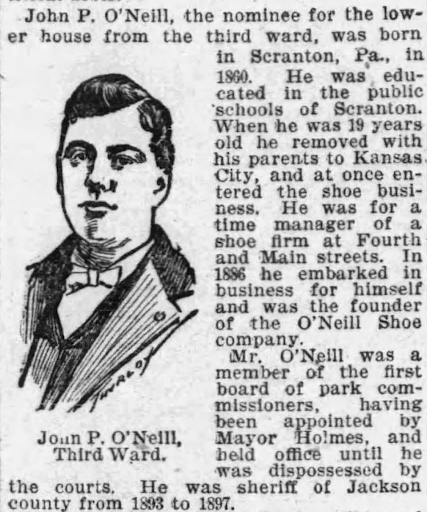
Kansas City Times, March 17 (St. Patrick’s Day), 1900
At 8 p.m. on Thursday, April 19, 1900, John Patrick O’Neill entered the chamber of the lower house of the Board of Aldermen as a duly elected member for the first time.
Newbie Alderman O’Neill was assigned, with Jim Pendergast, to the all-important City Finance Committee as well as the committee that oversaw the city’s lucrative gas franchise.
Big Jim exercised his growing clout on the council by getting his younger brother, Thomas, appointed as the city’s Superintendent of Streets.
Of course, it was only a matter of days before the defeated Republican demanded a recount and accused O’Neill of having enlisted voters known to be deceased.
…And Back Down Again
At the city Democratic Party convention in the spring of ’02, Jim Pendergast and rival Democratic faction leader Joe Shannon played nice for a change, and traded nominations of council candidates for the upcoming city elections. O’Neill figured he was a shoo-in to be nominated for re-election from the Third Ward. But he turned out to be the odd man out, and a fellow named Tony Lumpkin got the nod.
Buying a Seat in Congress – the Congress Buffet
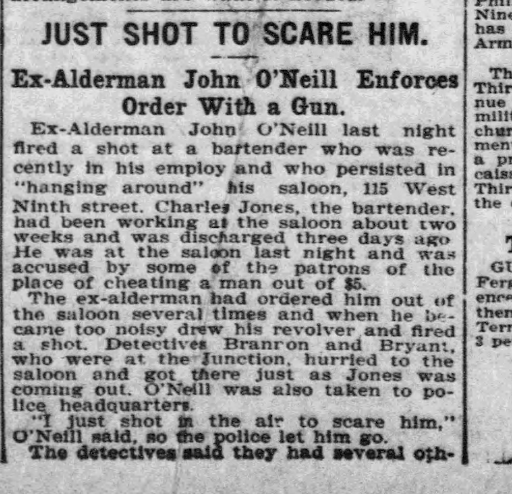
Kansas City Journal, June 4, 1904
John P. soon made amends with his nemesis from the spring convention and, with a partner, Charles R. Morgan, bought a saloon called the Congress Buffet on Ninth Street. Although the name of the place was not changed, it was referred to throughout town as “Johnny O’Neill’s joint.”
After the Pabst Brewing Company shuttered the Congress Buffet due to pressure from the city’s Shannon-aligned police board and after he was turned down for a license for another joint he wanted to open on Broadway, O’Neill, with a wink, announced plans to open a “temperance saloon.”
From the Kansas City Journal, July 24, 1904
SELLS SOFT DRINKS NOW
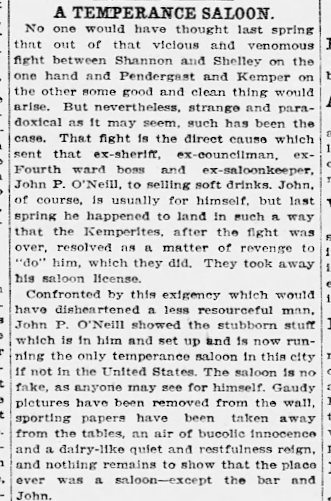
“O’Neill in the soft drinks business was too good a thing to lose, and the place did a rushing business. The old crowd all lined up to the bar and bought soda water and cigars, many of them taking the former for the first time since their earliest recollection. O’Neill hopes the commissioners will relent as soon as the storm has blown over and that he will be allowed to take out a dram shop license.”
November of 1910 saw a landslide of Democratic Party victories in Kansas City. As usual, Jim Pendergast, “King of the Foist,” won another re-election campaign by a huge margin – this time 3 to 1.
But just before Christmas, Big Jim, whose health had been failing over the last couple of years, announced that, on the advice of his doctor, he would not continue to serve as alderman. The fabled boss of “the bloody Foist” Ward passed away on Nov. 10, 1911, at the age of 55.
Return of O’Neill and the Emergence of ‘Boss Tom’
When young Tom Pendergast stepped onto the Board of Aldermen in 1911 to replace his late brother, he was welcomed as a logical extension of Big Jim’s strong, honest and likable character. When young Tom ran on his own accord for a second term in 1912 and again in 1914 (he would resign and turn his seat over to O’Neill in 1915), the future “Machine Boss” was still highly regarded by his colleagues at City Hall. In fact, in a speech given in 1914, Mayor Henry Jost gushed:
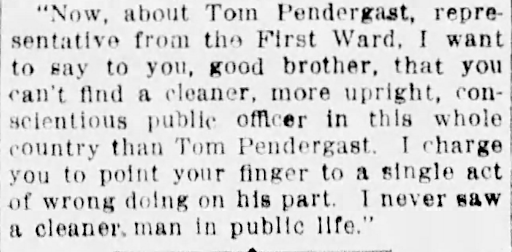
O’Neill Takes ‘The Pendergast Seat’ in Lower House
In 1915, Tom Pendergast resigned from the council to concentrate on the family business interests and because he was building and planning to move to a new home being built for him on Ward Parkway (outside the First Ward). He quickly designated John P. O’Neill, who had become a political mentor to him since brother Big Jim died, to take his place as First Ward representative in the Lower House of the council.
“From that hour, Mr. O’Neill’s rise in the leadership of his party continued until sometimes it was whispered that ‘Johnny’ ran ‘Tom,’ instead of taking orders from him.”
From a Kansas City Journal Retrospective, Dec. 13, 1922
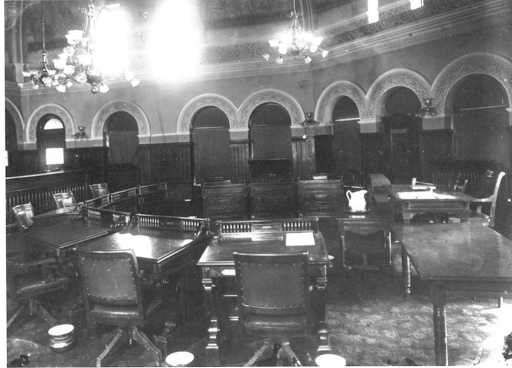
Taking the “catbird seat” in the council chambers first warmed by Big Jim, then by the future Boss Tom, John P. immediately took the lead in the Goats’ ongoing war with Joe Shannon’s Rabbit Democrats.
It didn’t take long for Alderman O’Neill to become “The Pendergast Bell Goat,” each week butting horns with Mayor Henry Jost and his Shannon-backed supporters on the council. As chairman of the lower house auditing committee, Alderman O’Neill called for an investigation into the Jost administration’s questionable spending practices – including alleged graft and padding the city’s payroll with Shannon supporters.
“O’Neill is now the dominant power in the ‘Goat’ machine, although Tom Pendergast is the titular head, because of his name.”
Kansas City Post, October 12, 1915
When asked, “Who is the boss?” an exasperated Mayor Jost countered:
“The question is whether John P. O’Neill or myself is transacting the business of the city. If O’Neill is the government, the sooner the people know it, the better. Johnny O’Neill will not stop at anything to accomplish his purposes, and there is nothing he will not stoop to.”
Although Alderman O’Neill would continue to dominate debates and voting in the lower house of the council throughout the rest of 1915 and early 1916, his road to election to a full term, starting in 1916, was littered with back-stabbing and more accusations of ballot box stuffing and self-enrichment. Beginning in 1911 or so, he had begun purchasing property where Crown Center is located now, having had inside information that the new Union Station was to be built across the street.
The local Democratic convention that year was painted by one scribe as “the bitterest battle of the Democrat factions in many years.” The Rabbit-strong Dems refused to nominate the “Bell Goat,” John P., and put up Shannon Rabbit lackey Denny Costello, owner of the Bijou Theater on East Fifth Street, as Democratic candidate for the First Ward seat. As a result, a lot of Pendergast’s “Goat” Democrats defected to the Republican side –temporarily.
Pendergast and O’Neill Engineer a ‘Goat Trick’
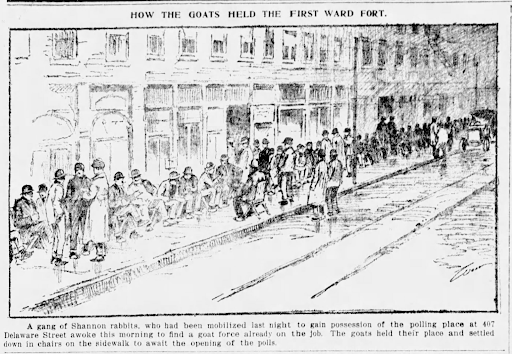
Kansas City Star, Feb. 17, 1916
With the backing of Tom Pendergast, John P. filed as the lone candidate running in the primary on “The Home Rule ticket.”
A smug Kansas City Post wrote: “Denny Costello’s opponent is John P. O’Neill, who has recently become an angel of righteousness with wings on his back – somewhat mussed – but whose former political record we have not bragged about. Never before has anyone arose in the First Ward to dispute the reign of the Pendergast family, which is behind O’Neill.”
O’Neill’s Goats Get Up Early, Catch Rabbits Sleeping
Before dawn on primary election day, an army of 200 or more Goat Democrats, most carrying folding chairs, descended on the First Ward polling place at 405 Delaware, and sat down or stood elbow to elbow on the sidewalk outside.
Next door to the polling place, upstairs in a “bed house,” lay some 100 snoring Rabbits, including Denny Costello, who all woke up to the voices of Pendergast and O’Neill men on the street below chanting, “Get up, cowards! Get up, cowards!”
Both groups had planned to flood the entrance to the voting place with their voters before the polls opened at 1 p.m. The O’Neill crew was the early bird.
Pistol Shots and Clouts on the Head
The Star observed that “someone fired a revolver twice from the bed house window, but the Goats did not waver. Then the Rabbits surged down the stairs. As each came out the door, he was promptly clouted on the head. A Rabbit expressed himself in vigorous terms. Crack went a fist to the jaw.
“The Rabbits drew back at that. They were not only outnumbered, but many of them were old men, while the Goat contingent had evidently been well-picked. The Rabbits capitulated and were ordered to walk a block away and disperse.”
The Post, of course, saw the conflicts on primary election day a bit differently, putting the blame for any and all violence on the followers of Pendergast and O’Neill. It described the clash this way: “Blood from broken heads and smashed noses flowed freely in the north end of the First Ward… guns were flourished, knives displayed, and clubs wielded at the very break of dawn. The Costello crowd resented the onslaught, and a free and general fight followed. The respective belligerents fought like demons, and blood smeared the sidewalks and side of buildings… until the Jost-dispatched police showed a partiality to the Pendergast/O’Neill crowd.
Having run unopposed as the “Home Rule” candidate, John P. O’Neill slid through the primary easily, living to fight for his seat on the council another day, i.e., the general election on April 5.
All in all, Rabbit-backed Democratic candidates, including Costello, did well in the primary and Shannon leaders quickly gloated over their successes. They promised to take out “Home Ruler” O’Neill in the general. One Shannon lieutenant was quoted as saying, “Among the missing (targets for takedown)” will be another familiar face, John P. O’Neill. A long voyage to him!”
As Election Day approached, the attacks on John P. grew in volume and nastiness.
Kansas City Post, April 2, 1916
TO OUR LOYAL CITIZENSHIP
“A blight of Asiatic cholera or smallpox would do less to harm this city than the exaltation and election to office of such a man as John P. O’Neill. Have we as a people no shame, that we would even consider putting back in power such a confessed and proven rascal as O’Neill?
“O’Neill was placed in the council by Thomas J. Pendergast, the owner of the Jefferson Hotel. Pendergast resigned and left the place for him. He is Pendergast’s leader in the lower house, and the aldermen of the lower house who jump at his every beck and call are mere puppets, who become active when O’Neill pulls the string.”
Accusations of intimidation and vote fraud flew from headlines in the Post even before the polls closed on Election Day.
Kansas City Post, Tuesday, April 4, 1916
CONFESS SELLING VOTES
Dozen Arrested on Charges of Bartering at Polls
Workers Came Out of Back End of Saloons and Alleys
All are O’Neill Men
By 10 a.m., the first of several bloodied voters staggered into police headquarters, one with an eye swollen shut, bruised and bleeding, and holding his side where he had been kicked.
Thomas Morris, a lithographer, said he had been beaten up in an alley after voting for O’Neill. “I was asked how I wanted to vote,” he told a mostly disinterested officer. “I told them I wanted to vote for Edwards and O’Neill. After I had voted, Costello and another man followed me out and rushed me into an alley, beat and kicked me until I was almost unconscious.”
Reports of ballots being switched came from precincts throughout the city. Witnesses told of seeing Shannon-appointed judges of election hiding ballot boxes under tables.
The Star’s observer who chronicled the chicanery wrote: “Ballots were palmed by friendly officials and every conceivable sort of election booth trickery resorted to. Voters wearing opposite emblems were slugged repeatedly. Rabbit workers rushed to the polls and blocked off anti-Shannon voters. Controlled voters were herded into the polling booth, and then ballots unfolded to see that they had voted ‘right.’ Whiskey and money were used openly wherever votes could be bought.”
The Post called Election Day in the First Ward “An Orgy of Criminality.”
When the dust cleared, George H. Edwards, the Republican candidate for mayor backed by Pendergast and O’Neill, emerged the victor in a landslide, beating the incumbent Jost by 8,206 votes. “Home Ruler” John P. O’Neill sent Denny Costello back to sweeping popcorn at his movie theater, winning 1,796 votes to the Shannon man’s 1,020.
‘Brains of the Goat Gang’ at City Hall
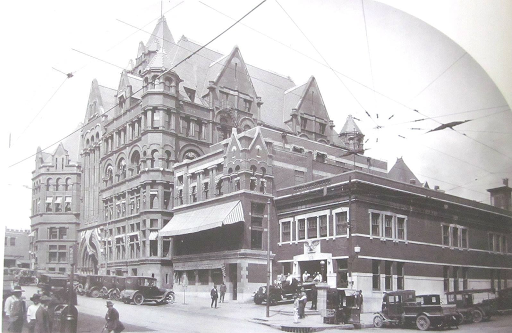
The old city hall on Main Street, between Fourth and Fifth streets.
From 1915 through the end of 1922, Johnny O’Neill was considered the chief strategist and ruling whip of what would soon be called “The Pendergast Machine.” He was acknowledged, even by his foes, as a savvy master of the art of political compromise.
Not educated much past the ninth grade, Johnny’s speech was unrefined: “not often grammatical, but forceful,” as one scribe put it. He had a peculiar raspiness in his voice and an ever-present half-smoked, half-chewed cigar lodged between his teeth.
Alderman O’Neill always arrived early to the regular evening council meetings and took his seat at the head of the room. As the other aldermen arrived – his “satellites,” the Star called them – they would gather around him and “get the line-up for the evening.”
In the council chamber, his chair and desk were the first in the circle of seats in front of the speaker’s stand. He rarely stood up to speak, but rather stayed slouched in his chair. He gave orders in the form of “suggestions.”
“He would address no one in particular,” noted a reporter for the Post, “yet every man within sound of his voice followed the ‘suggestion.’”
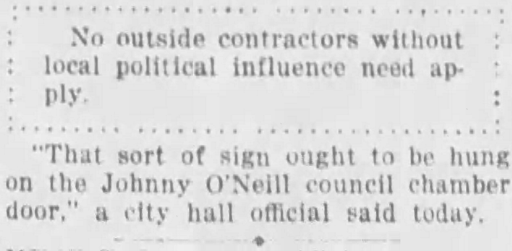
His 13 alderman colleagues in the lower house knew that when John P.’s cigar darted from one side of his mouth to the other, Johnny didn’t like what he was hearing.
For Alderman O’Neill, 1919 was a busy and especially productive year. He manipulated legislation, contracts, and permits in favor of friendly local union construction contractors, billboard companies, and the dominant streetcar and telephone franchises.
J.P. the Party’s ‘Diogenes’
As Democrats were preparing for the upcoming city elections in 1919, the friendly Times referred to O’Neill as the party’s ‘Diogenes,” in reference to the Greek philosopher who, mythology has it, carried a lamp in the daytime while looking everywhere for an honest man because he viewed the people around him as dishonest and irrational: “Alderman John P. O’Neill, who occupies a seat on the ‘Goat’ throne, on the right hand of the all-powerful one, is looking for the candidate, a Democrat that will be acceptable to both factions.”
O’Neill determined that he himself was the candidate he was looking for in 1919.
Whereas the mayoral candidate squeaked by, winning his election by only 2,117 votes, O’Neill had that many votes cast in his favor before noon. His loyal supporters (living and dead) in the old First Ward came out in force to put Johnny over his Republican opponent, 4,433 votes to 446.
One reporter described the process in Johnny O’Neill’s First Ward as “the floating vote,” noting that “In the morning came the loyal Democratic voters, followed by ‘the repeaters,’ and ‘ghost voters,’ who came to the polling places holding a slip of paper with someone’s name and address on it, which they repeated to the election judge, and quickly cast Democratic Boss ballots.”
While the size and scale of the 1919 “ghost vote’ may have been a wee bit exaggerated, it was not terribly uncommon for legitimate first-time voters to find, when they got to their polling place, they had already voted.
Hear No Evil, See No Evil
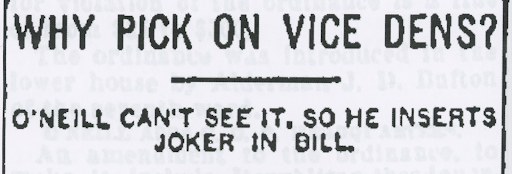
Kansas City Times, Jan. 25, 1921
A serious ordinance calling for the telephone, gas, and electric companies to stop furnishing services to all “gambling houses, houses of prostitution, besides other immoral resorts” was put before the lower house of the council. A straight-faced John P. tagged an amendment onto the resolution to make the ordinance include the local Republican headquarters.
The ‘Diogenes’ Rumored to Be Dying
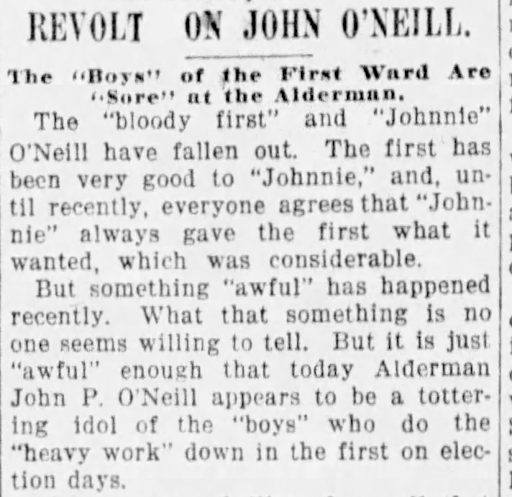
Kansas City Times, July 8, 1921
In 1921, rumors began circulating that Johnny O’Neill had done something to make the younger Turks of the Goat faction sore and that they were plotting to push him aside as their leader.
Noted the Star: “For nearly thirty years, O’Neill has been a leader in the Pendergast faction. He has been considered the shrewdest politician in the entire ‘Goat’ organization. But the First Ward alderman is 61 years old, and his health has not been good for some time.”
Re-energized after a month-long convalescence in the pine forests of Gulfport, MS, O’Neill came back to the council with a vengeance in February of 1922. To the dismay of the Turks, it looked like he was going to run again. The wily veteran immediately took charge of the Dems’ campaign planning and strategizing.
As the April election drew closer, the Times saw what was coming and wrote: “City taxes have been levied by the common council controlled by the iron hand of Johnny O’Neill. The main issue is whether you want one man, Johnny O’Neill, dictating the time, place, and terms of every public improvement, by his autocratic control of the common council, or whether you want to control your own city affairs through chosen representatives responsible to the voice and the interests of all the people.”
At a gathering of some 300 Republican workers at Surber’s Cafeteria at 10th and Walnut, just beneath the Democratic headquarters, the meeting began with the following being sung loud enough for the Goats upstairs to hear it:
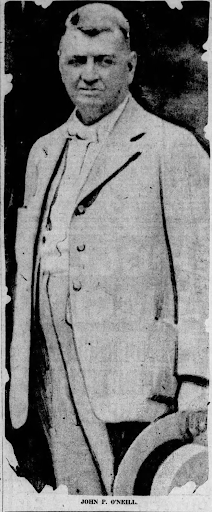
John O’Neill.
JOHNNY OWE NEEL
(Sung to the refrain of “Peggy O’Neill”)
If he delights in the council nights,
That's Johnny Owe Neel.
If he's scheming all the evening,
That's Johnny Owe Neel.
If he talks with a brogue -
If he's acquainted with every town rogue.
Czar-like autocracy-- goat-like democracy...
That's Johnny Owe Neel!
One More Sweep for ‘The Boss Ticket’
In 1922, once again, the O’Neill-and-Shannon-orchestrated Democrats came away with a huge win, including the office of mayor, with Frank H. Cromwell, and all seats in the upper and lower houses of the council.
Just before Christmas, with the victory celebrations over, Johnny O’Neill died in his room at the Coates House Hotel.
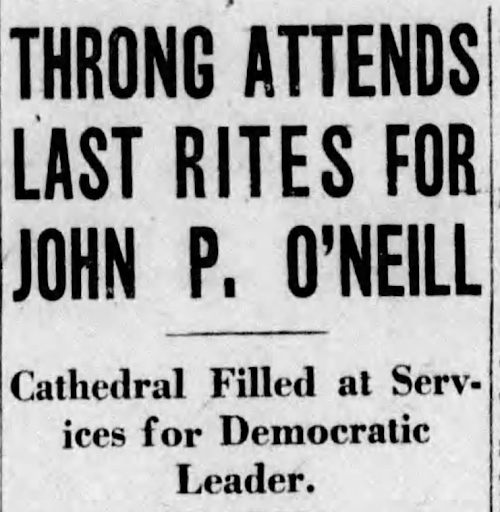
Kansas City Post, Dec. 19, 1922
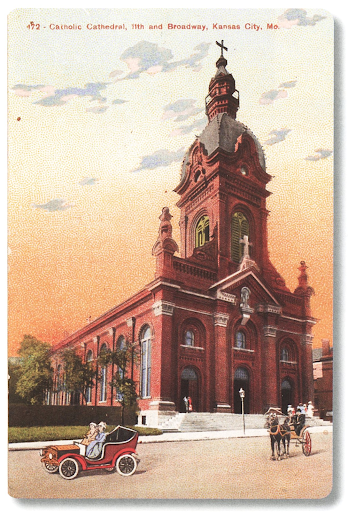
On the morning of Dec. 18, 1922, John Patrick O’Neill’s body was carried in a long procession to the Cathedral of the Immaculate Conception at 11th and Broadway, where the Rev. Cornelius McCarthy, a native of Beare Island in County Cork, Ireland, said the funeral Mass.
According to the Post, “Civic leaders, the mayor, judges of courts, city councilmen - men and women of every walk of life – attended the ceremony. It was estimated 2,500 persons filled the Cathedral.”
News of O’Neill’s passing reached old acquaintances back in Pennsylvania, through the Scranton Times, which reprinted these final words from the Kansas City Post:
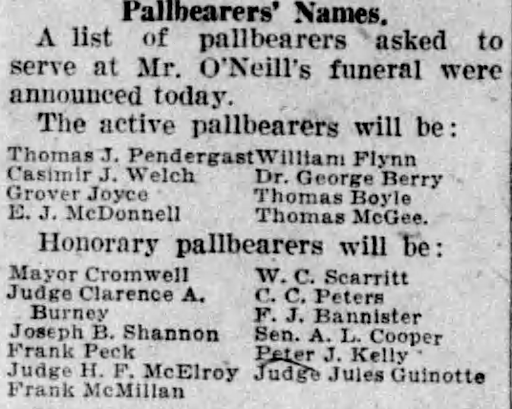
Kansas City Post, Dec. 14, 1922
“… upon the retirement of Tom Pendergast as alderman from the First Ward, Mr. O’Neill stepped into the limelight again as Pendergast’s successor. From that hour, Mr. O’Neill’s rise in the leadership of his party continued until sometimes it was whispered that ‘Johnny’ ran ‘Tom. He was the ‘brains’ of the Pendergast faction. No man, even his enemies admitted, could better gauge the political future than ‘Johnny’ O’Neill.”
Johnny O’Neill was gone. But he had lived just long enough to see Jackson County voters in November elect a Pendergast Machine newcomer as eastern county judge. His name was Harry Truman.

Pat O’Neill is a local historian and author.