
Our Twelve Photos of Christmas
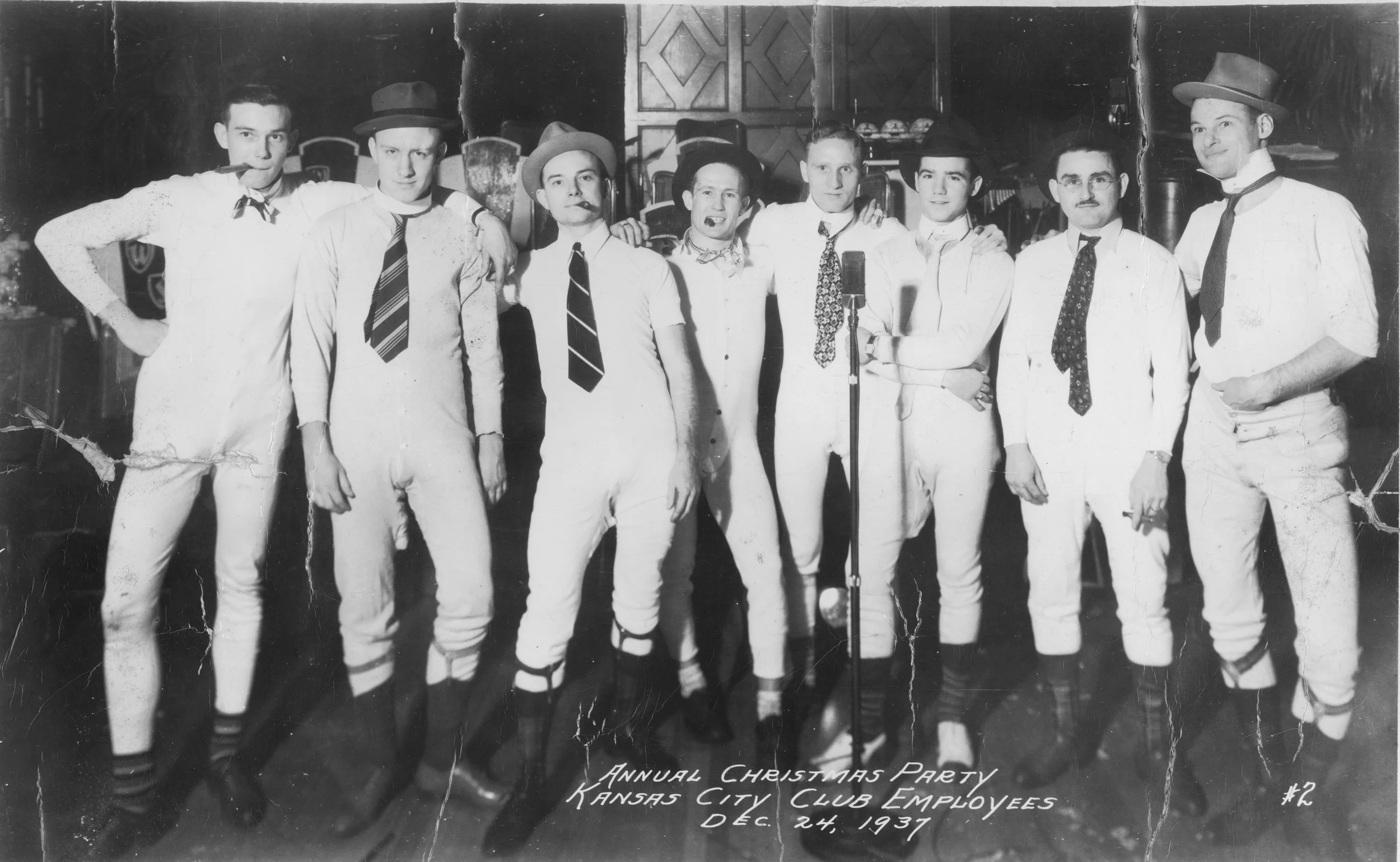
Annual Christmas Party of the Kansas City Club Employees, Dec. 24, 1937. Group photo of eight men with ties, but without their trousers and wearing long johns. JCHS Image No. PHL 5547
Back in the day, there were “photo albums.”
Families would curate them by pasting or taping in hard-copy photos, sometimes also called “snapshots.”
Often such albums would be filled with pictures documenting special occasions or holidays, such as Christmas.
We here at the Jackson County Historical Society have a pretty big photo album. It’s called the Digital History Database (https://jchs.catalogaccess.com/).
For the holiday season we decided to enter the keyword “Christmas” into its search engine, and many photos appeared.
In observance of the season we present our 12 days, uh, photos which appear below.
They document how Jackson County residents over the years observed the holidays. We found images of Christmas cards, trees, dances, dinners, office parties and more.
Friendly reminder: While the Society is always ready to welcome new members, you don’t have to be a member to browse through the database and order prints or digital files. Go to https://www.jchs.org/archive-orders
Give it a try. Maybe you’ll find something we missed. And happy holiday season from the Jackson County Historical Society.
By Brian Burnes
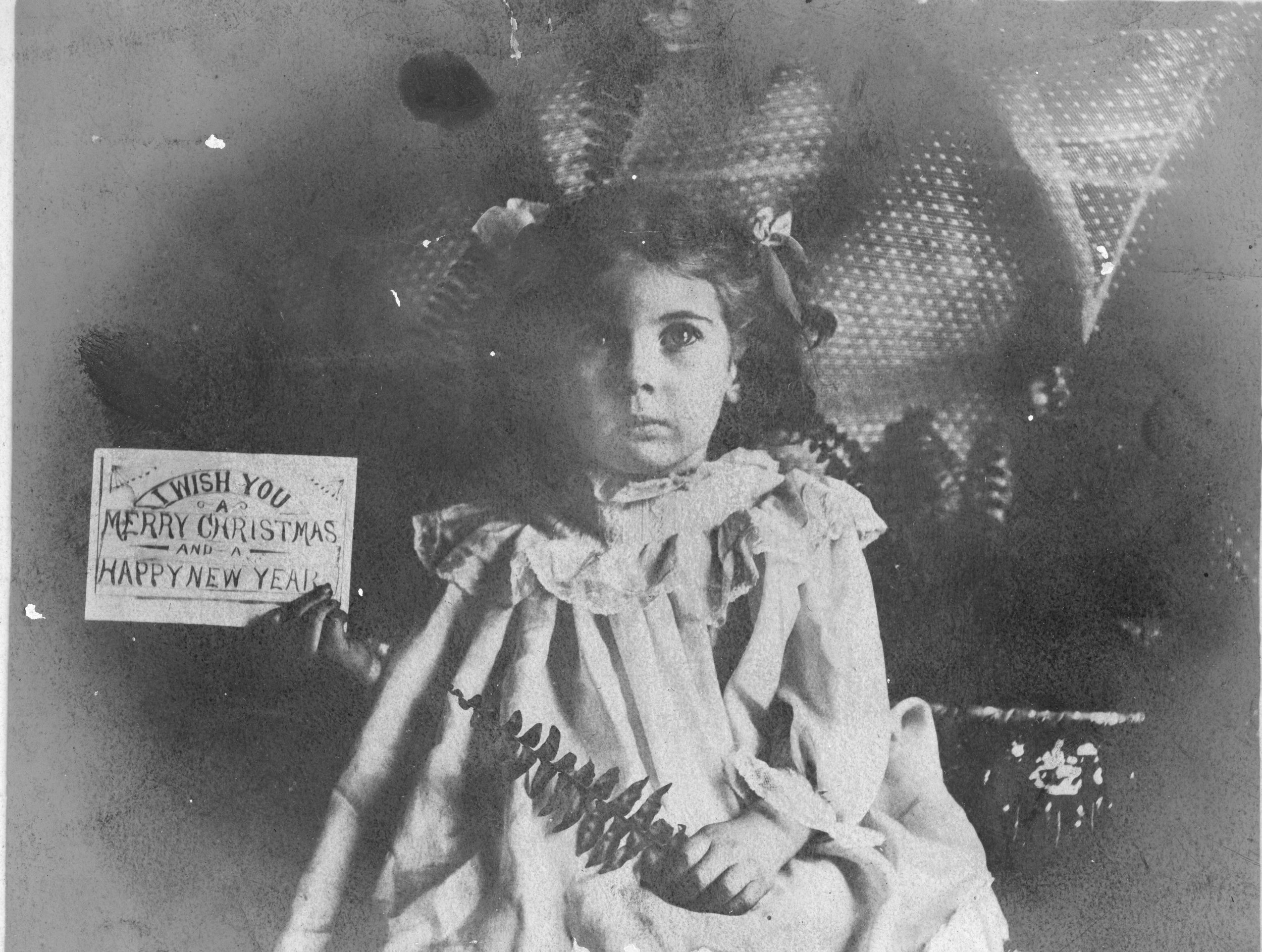
1903 Calendar, with oval photo print of a young unidentified girl, with caption, "Wishing you a Merry Christmas and a Happy New Year". JCHS Image No. PHL 2552
CHRISTMAS CARD, 1903
Joyce Hall, founder of Hallmark Cards, arrived in Kansas City from Nebraska in 1910 carrying two shoeboxes of postcards.
He sold the cards, and prospered.
Siblings soon joined him, and by 1913 they were selling cards that slotted into envelopes and carried specific greetings.
They introduced Christmas cards two years later.
The Hall family filled a need. Making Christmas cards was a lot of work, as this home-made card from 1903 suggests.
Someone - we don’t know who - started with a photograph of a young girl holding a sign reading “Merry Christmas” and “Happy New Year.” Then the unknown sender found a small 1903 calendar, and affixed both to a piece of thin cardboard.
If the card today would not merit Hallmark’s familiar Gold Crown sticker, its sender still cared enough to send the very best.
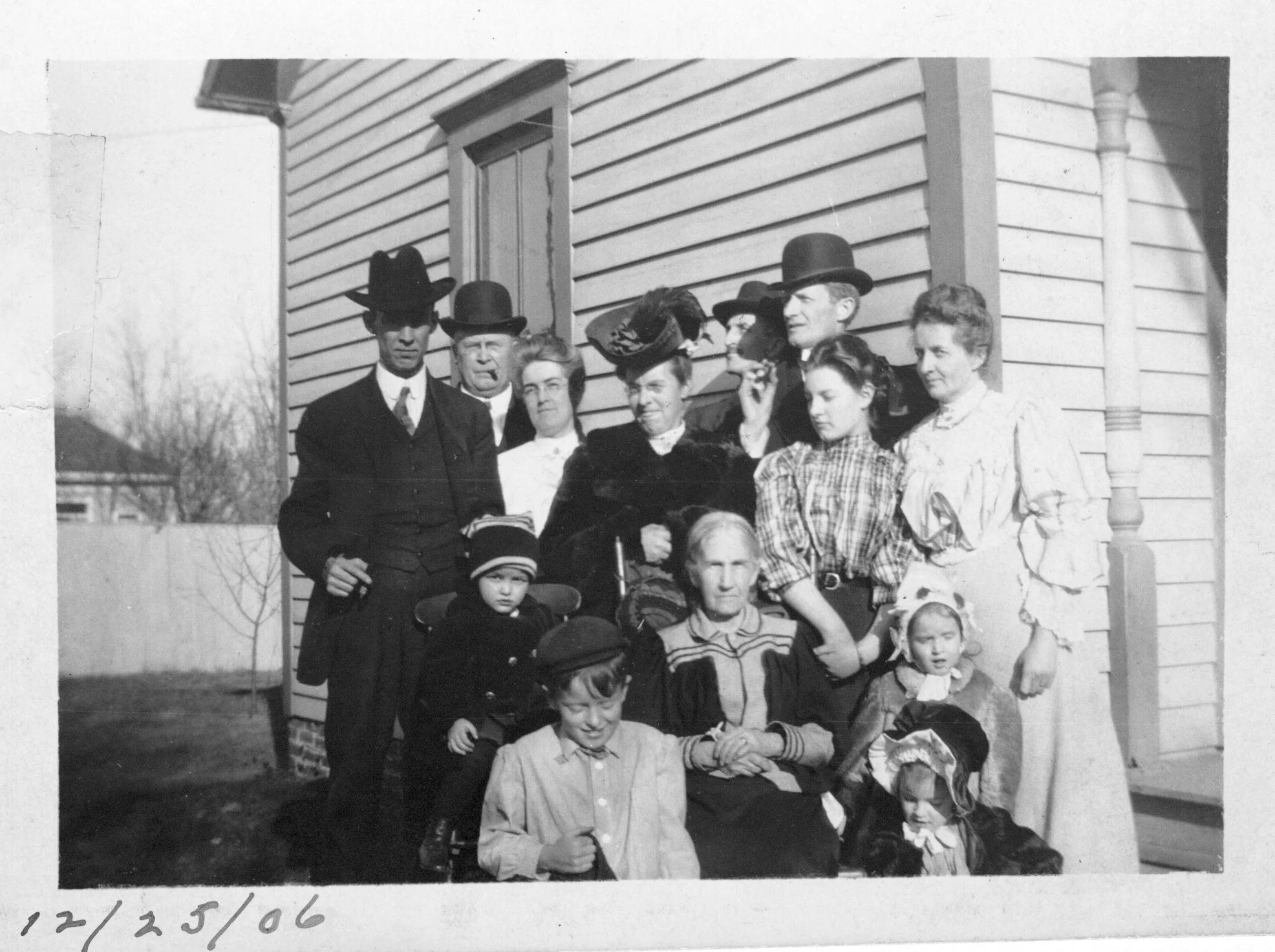
Family group at 521 S. High Street Dinner Party, in front of house on Christmas Day. JCHS Image No. PHS 4424
UNIDENTIFIED FAMILY PHOTO, CHRISTMAS DAY, 1906
We don’t know the name of this family.
But we know what a family Christmas picture looks like.
In this one, the matriarch is seated in the center. She is flanked by four children who appear distracted, and the disinterested young woman at Grandma’s left appears to be in desperate need of her iPhone.
The handwritten date at the bottom documents the date as Christmas Day, 1906.
We don’t know if this family used a Kodak camera to take this picture - but it could have.
The Kodak Co. of Rochester, N. Y. first marketed its easily usable box camera in 1888 with the slogan, “You press the button, we do the rest.” It came with 100 exposures of preloaded film; once all those had been used, owners brought the camera back to order the finished photos.
In December of 1898, Rhodes Brothers Photo Supplies and Opticians at 919 Walnut St. in Kansas City advertised the Kodaks at $1.80.
The camera not only allowed amateurs entry to the world of photography, it also transformed how people presented themselves in portraits, given that the Kodak made possible pictures that were more casual.
The Kodak company, seizing the moment, introduced the $1 “Brownie” camera in 1900, helping to introduce the word “snapshot” to general use.
Some Kansas City retailers used the Brownie as a loss leader to get customers inside their doors to perhaps buy other, more profitable merchandise.
In December, 1900, the Schmelzer Arms Co., a firearms and outdoor recreation store at 700 Main St., advertised the Brownie for 80 cents.
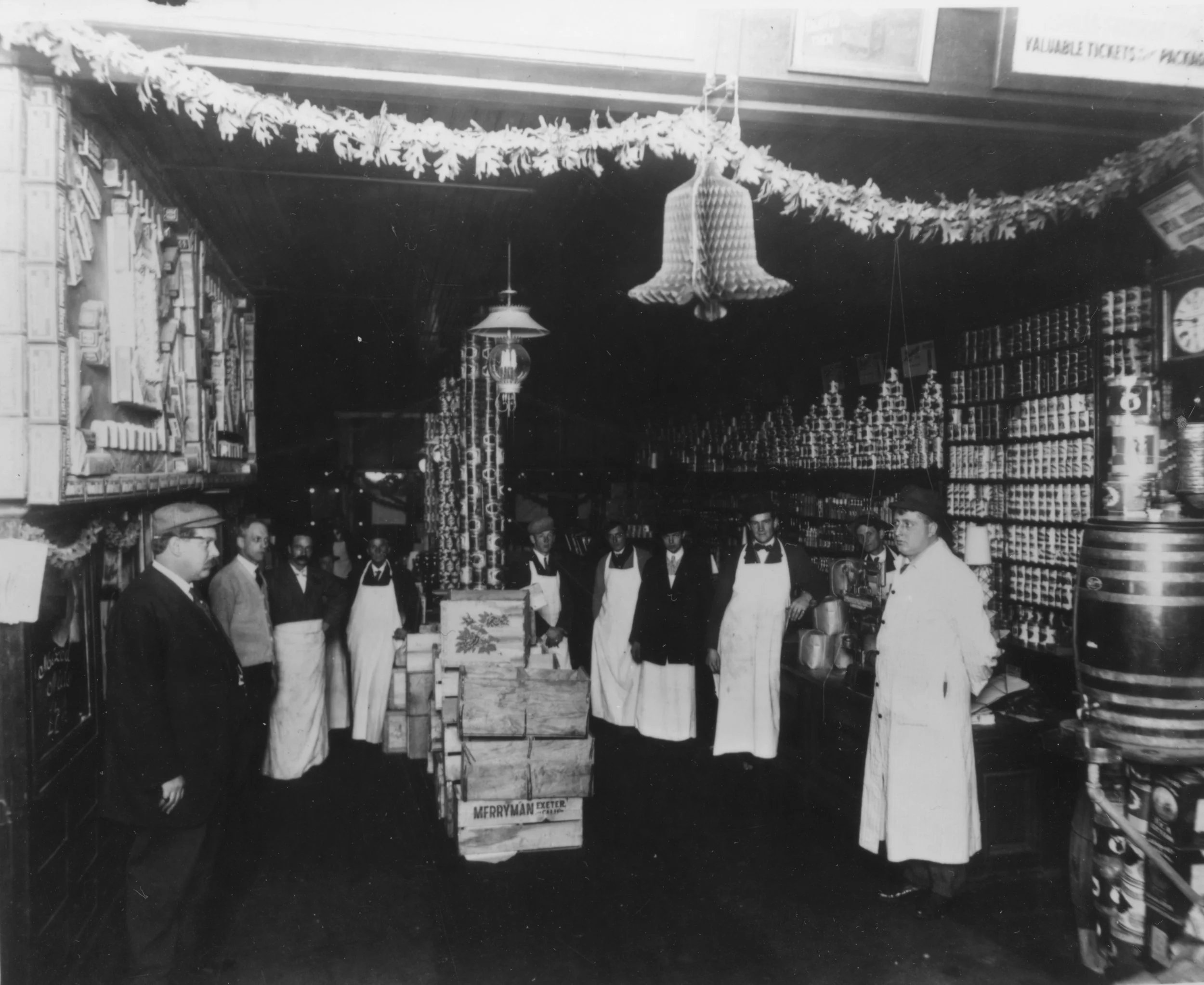
John F. Wiedenmann & Brothers Groceries, Meats and Feed, interior, with Christmas decorations. This building was the former outfitting store of Albert G. Boone, later Westport Inn, today Kelly's (2005). JCHS Image No. PHS 11197A
WIEDENMANN STORE, CHRISTMAS EVE, 1910
The building at 500 Westport Road long has been the unofficial Kansas City center of gravity for things Irish.
But the family that operated a store at what today is known to all as Kelly’s arrived from Germany in 1854.
The John F. Wiedenmann & Brothers Groceries, Meats and Feeds store operated at the address from 1904 through the 1930s. The Wiedenmann family continued to own the building for several decades after that.
The two-story brick building often is considered to be the oldest structure in Kansas City, although that sometimes has been disputed. That didn’t stop it from being listed on the National Register of Historic Places in 1972.
What is not at dispute is the role the property - and the entire intersection of Westport Road and Pennsylvania Avenue - plays when Kansas City feels the need to celebrate. When the Kansas City Royals won the World Series in 2015, the Kansas City Fire Department parked a pumper just steps from Kelly’s front door, from which firefighters posted themselves, keeping an eye on the revelers.
Two traders named Ewing built the store in 1850, just in time to prosper off the remaining years of reliable merchant traffic headed southwest on the Santa Fe Trail.
In 1854 they sold it to Albert G. Boone, a grandson of Daniel Boone, the explorer and frontiersman. He ran it for several years before selling out in 1859.
Beginning in the early 1900s the Wiedenmanns ran a grocery and supply store at the address and on Christmas Eve, 1910, their employees stood for a formal photograph underneath a string of holiday decorations.
By 1934 the building housed a saloon known as the Wrestlers Inn, which that year received a liquor license, not long after the repeal of Prohibition.
It soon became known as the Westport Inn.
In 1977 the bar’s official name became “Kelly’s Westport Inn” because of Randal Kelly, a County Clare school teacher who immigrated to America in 1926 and hired on in 1947 as a bartender known for his distinctive Irish brogue.
His customers began referring to the bar as “Kelly’s.”
Following Randal’s 1988 death, other family members continued to operate the bar, and in 1995 they formally acquired the building from the Wiedenmann family.
A third generation of Kelly family members now runs the tavern.
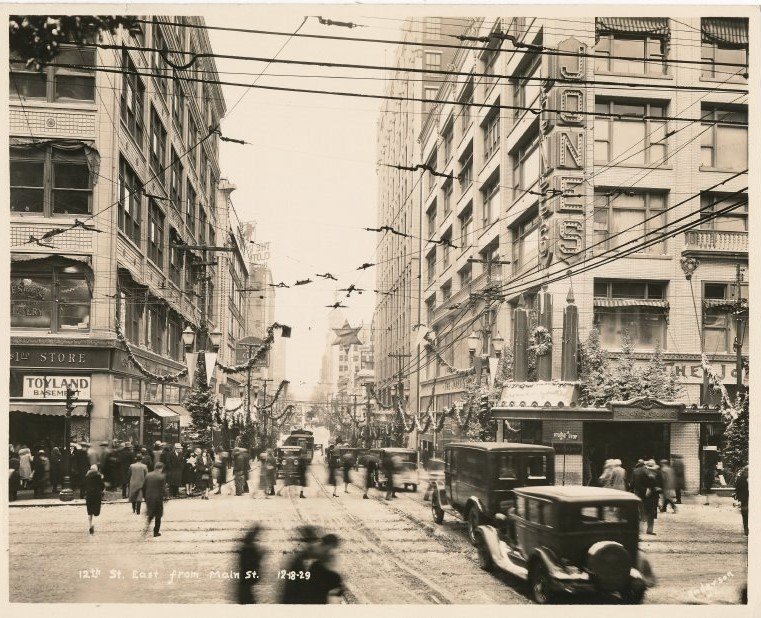
12th St. looking east from Main St. in Kansas City, Missouri. JCHS Image No. 1973.098.979
DOWNTOWN KANSAS CITY, 1929
If the Great Depression actually began with the October, 1929 crash of the Wall Street stock market, Kansas City Christmas shoppers that December had yet to receive that memo.
“A Surging Torrent of Humanity Floods the Canyons of the Downtown Business District As Kansas Citians Start Their Christmas Shopping” read the Kansas City Star headline above a photo of the intersection of Walnut Street and “Petticoat Lane” (11th Street) taken on Saturday, December 7.
The surging torrent may have crested, momentarily, by December 18. That’s when the Albert Schoenberg Realty and Investment Co. asked that a photo - looking east from 12th and Main streets - be taken.
The core of Kansas City’s downtown retail sector was in place by 1929.
The Jones Store, which can be seen in the photo, opened its seven-story facility at the 12th and Main intersection in 1902.
About one block to the north shoppers could find what by 1929 had become known as “Petticoat Lane,” so named in part because of its cluster of stores that prominently sold women’s wear. Those included Kline’s, which opened at 1125 Main St. in 1906; Harzfeld’s, which opened at 1101 Main St. in 1913, and Peck’s, which opened at 1144 Main St. in 1914.
Perhaps the most celebrated merchandise house - Emery, Bird, Thayer - with its open-air arcade along Grand Avenue, had opened in 1890 two blocks east at 11th Street.
Some of the stock advertised in the December 18 Kansas City Star was on the posh side.
Woolf Brothers at 1020 Walnut St. offered men’s silk top hats for $20 (about $380 today); Kline’s advertised women’s fur scarves for $39.75 (about $750 today), and Goldman’s at 1107 Walnut St. offered “Gentleman’s Diamond Rings” for $100 (about $1,895 today).
Times were good for downtown retailers - for the moment.
Still, the first buildings in the Country Club Plaza, the fledging shopping district being developed by real estate entrepreneur J.C. Nichols, had opened in 1923.
Today that is considered the first planned large outdoor “suburban” shopping center in the United States.
The Plaza, plus the several enclosed suburban shopping malls which would open across the Kansas City over the decades, would hollow out the downtown Kansas City retail district.
Metcalf South in Overland Park, considered the first enclosed shopping mall in the Kansas City area, opened in 1967.
Three years later Kline’s closed its downtown location. That ended the store’s annual holiday “Fairy Princess” holiday promotion, which it had introduced in 1935.
The Museum of Kansas City revived the attraction in 1987, and has continued to offer it through this year.
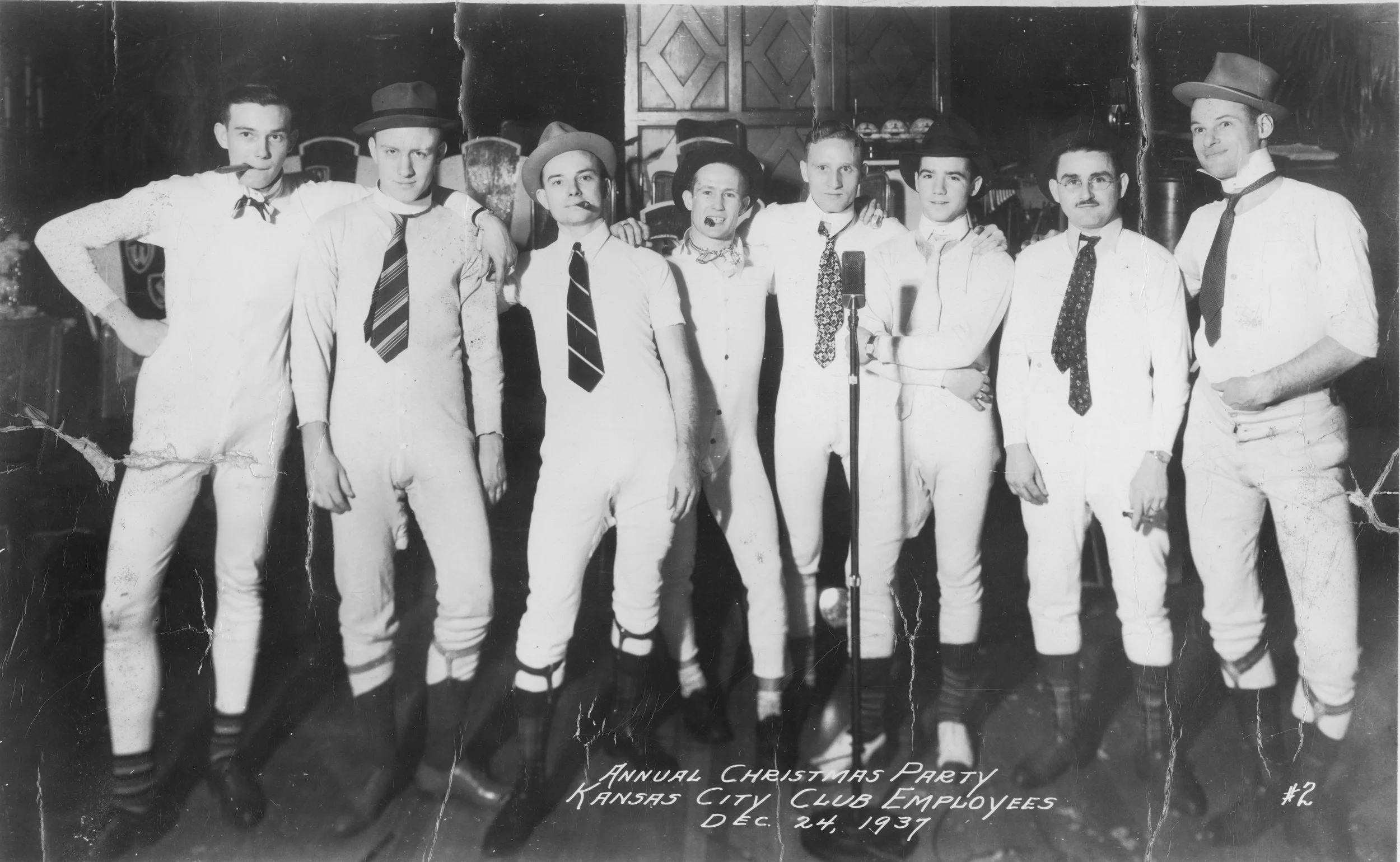
Annual Christmas Party of the Kansas City Club Employees, Dec. 24, 1937. Group photo of eight men with ties, but without their trousers and wearing long johns. JCHS Image No. PHL 5547
THE KANSAS CITY CLUB, 1937
The oldest of what once were called “gentleman’s clubs” was the Kansas City Club.
Founded in 1882 by prominent businessmen, for decades it occupied a 14-story headquarters at 1228 Baltimore Ave.
Many gentlemen belonged, chief among them Harry Truman, who famously played poker there after returning to Jackson County from the White House in 1953.
In the 1930s the club often hosted Christmas parties that included comic theatricals; this photo presumably depicts cast members from the 1937 show.
Another men’s organization that mounted such productions was the University Club, which staged occasional “Nit-Wits” satires.
In 1973 a two-paragraph item in the Kansas City Times noted that women had appeared for the first time as “Nit-Wits” cast members.
This was considered newsworthy, as both the University and Kansas City clubs for decades had not admitted women as members.
That finally changed in the 1970s.
Women of Kansas City, meanwhile, had needed neither club to find community and solidarity.
Sarah Chandler Coates, wife of real estate developer Kersey Coates, in 1870 organized the Women’s Christian Association, often considered Kansas City’s oldest charitable organization.
The Kansas City Athenaeum, a women’s club which for decades operated out of its Greek-columned building at 900 E. Linwood Boulevard, formed in 1894. Its members advocated on behalf of various social welfare initiatives, as did the Woman’s City Club, organized in 1916.
Members of the latter organization played a significant role in the 1940 election of reform mayoral candidate John Gage, which toppled Kansas City’s Pendergast political machine. They campaigned wearing pins that featured an instrument of domestic drudgery - a broom - symbolizing the election that would sweep machine members from City Hall.
The Kansas City Club and the University Club merged in 2001 and operated under the Kansas City Club name at the University Club building at 918 Baltimore Ave.
The club closed in 2015, with the building reopening three years later as a wedding and event venue.
The University Club had been organized in 1900 by graduates of elite colleges who - voluntarily or otherwise - had found themselves working in Kansas City, what their fellow alums may have considered a wilderness outpost.
Their “smokers” could be clubby in the extreme, and the newspaper reporters of the day were not above gently dinging the swells for their Ivy League lineage.
On November 15, 1902, the Yale University Bulldogs defeated the Princeton Tigers in that year’s football matchup. A Kansas City Star accounting of the University Club’s subsequent gathering detailed the mock humiliation endured by the Princeton men, presided over by a Yale graduate skilled in verse.
“Then came the fight, with main and might,” he recited,
“each strove to do his best.
“But presently ’twas plain to see,
“The tiger was distressed.”
Nearly 100 club members attended. The president of the club’s Yale chapter spoke and, according to the Star, “many college songs were sung.”
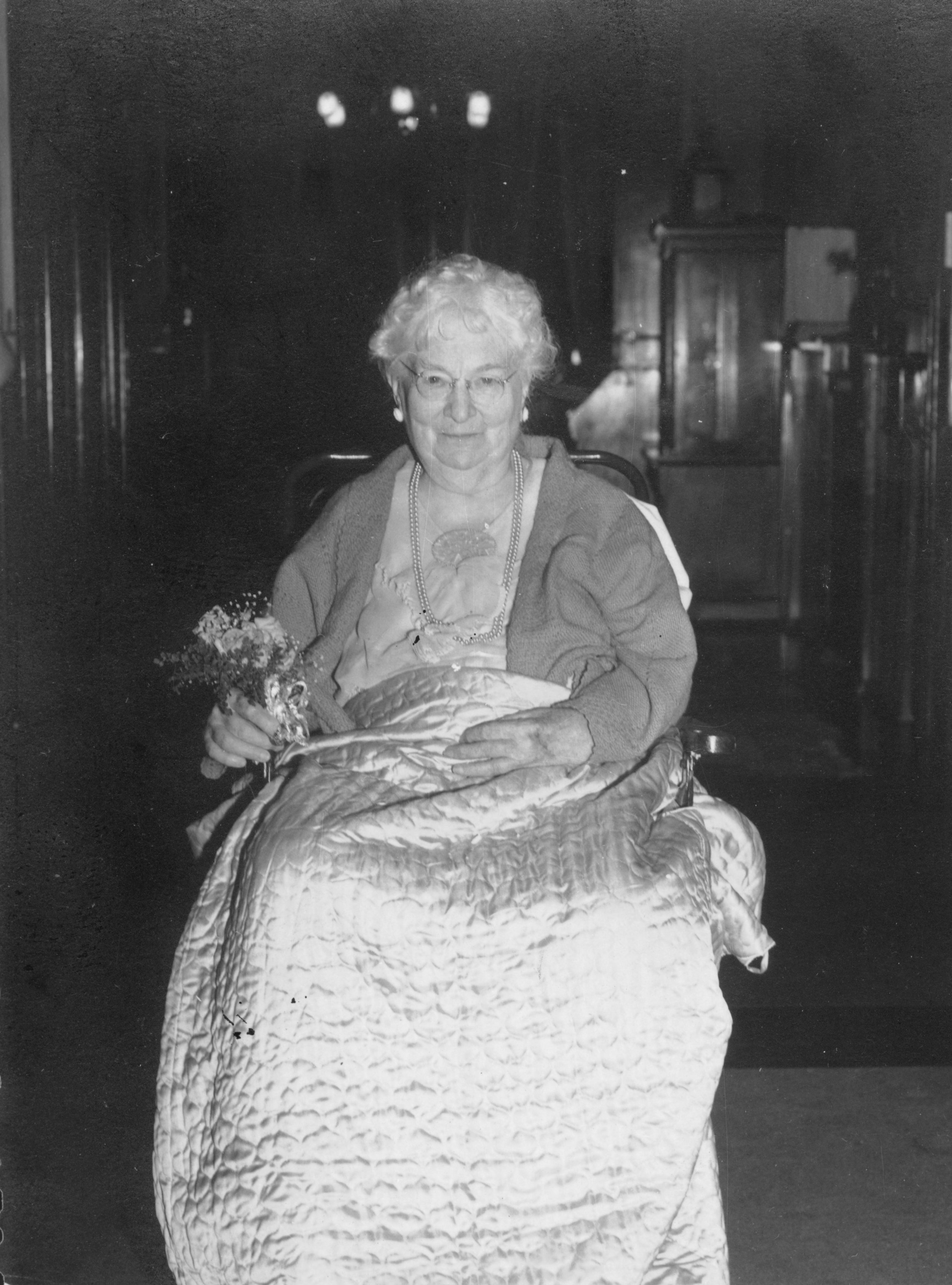
Margaret Chrisman Swope, taken shortly before she died. JCHS Image No. PHS 199
MARGARET “MAGGIE” CHRISMAN SWOPE, 1941
Margaret Chrisman Swope sent out her last Christmas cards at age 86.
Her maiden name was then, and remains, among the most meaningful in Independence history.
Yet it is her married name that resonates with those fascinated by what became one of the most infamous murder trials in Missouri history.
In 1877 Margaret - routinely known as “Maggie” - married Logan Swope, the brother of Thomas Swope, the Jackson County real estate investor and philanthropist who died suddenly in 1909 after swallowing capsules given him by local physician Bennett Clark Hyde.
(To get the full compelling story, seek out “Deaths on Pleasant Street,” published in 2009 by longtime Kansas City Star film critic and staff writer Giles Fowler. That year the Jackson County Historical Society honored Fowler for his book.)
But Mrs. Swope’s far more meaningful legacy must be the education of generations of Independence students at Chrisman High School.
In 1917 she sold - for $1 - land at West Maple Avenue and North Union Street on which the Independence School District built Chrisman High School, named for Mrs. Swope’s father, William Chrisman, an Independence banker and lawyer.
In 1956 the district opened a new Chrisman High School near the intersection of Noland Road and U.S. 24.
Mrs. Swope, born in 1855, spent many of her later years in what today is the known as the Vaile Victorian Mansion, an opulent three-story home built in 1881 at 1500 N. Liberty St. in Independence. Today the building is operated as a museum.
In the early 1940s the building served as a sanitarium and that is where she spent her last Christmas. The information included with this photo reads “Taken shortly before she died,” along with “In Vaile Sanitarium where she wanted to be.”
Mrs. Swope died on Jan. 21, 1942.
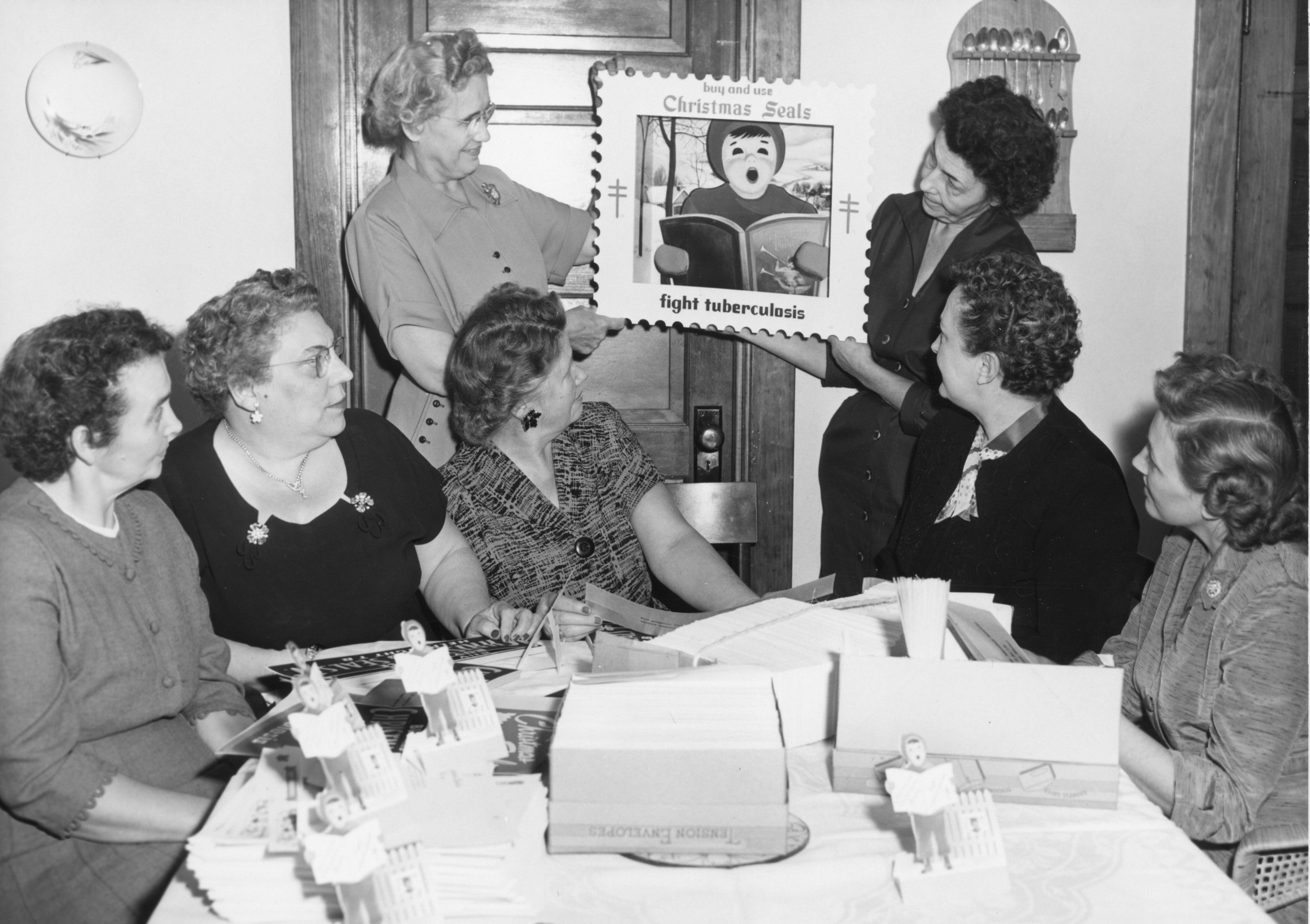
Jackson County Tuberculosis Association workers, with their Christmas Seals posters. JCHS Image No. PHM 12948 A
JACKSON COUNTY TUBERCULOSIS ASSOCIATION, 1953
In 1953 public health representatives visited 61 schools across eastern Jackson County.
They tested 5,099 students for evidence of tuberculosis.
The initiative was funded in part by the annual sale of Christmas seals, small labels featuring holiday designs that residents could affix to their Christmas cards or other mail.
This photo depicts members of the Jackson County Tuberculosis Association reviewing that year’s Christmas seal. Although this photo is undated, the design of the seal shown was used in 1953.
A postal clerk in Denmark came up with the initial idea 50 years earlier as a way to raise money for tuberculosis research.
The Delaware Red Cross embraced it in 1907 at the urging of Emily Bissell, the organization’s secretary.
Danish-American photographer Jacob Riis, known for his portraits of impoverished newsboys illustrating early 20th century New York tenement life, also championed the idea. Riis had lost six siblings to the disease.
After President Theodore Roosevelt endorsed the program in 1907, the practice grew across the country.
The Jackson County Tuberculosis Association dates back to at least 1925, when an advertisement in the Independence Examiner listed the names of 21 area physicians who endorsed the holiday sale of Christmas seals.
The ad promised that the money raised would be used to fund a tuberculosis nurse serving eastern Jackson County.
County residents responded with strong support, buying the stamps at banks and post offices, and also sending in donations after receiving sheets of seals in the mail.
In 1942 the Independence association chapter mailed out sheets of the seals to 7,500 recipients, who then responded with donations, the Examiner reported that year.
In 1954 the association sent out 19,500 such mailings.
Today the American Lung Association, which holds the trademark on the seals and still markets them, describes the threat of tuberculosis as “largely controlled” in the United States in part due to the development of powerful antibiotics first introduced in the 1940s.
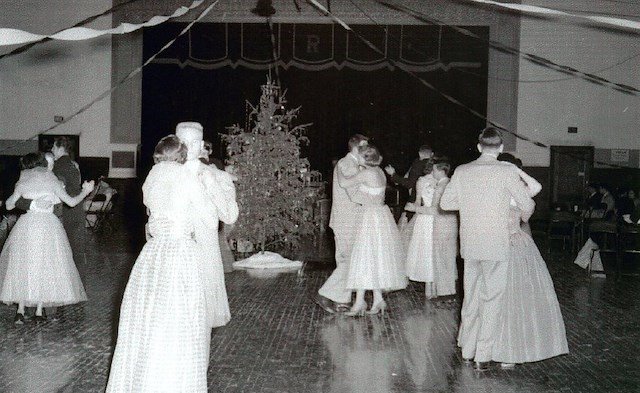
Ruskin High School Christmas Dance, dated December 19, 1953. JCHS Image No. PHS 15451 H
CHRISTMAS DANCE, RUSKIN HIGH SCHOOL, 1953
Time machine inventor Doc Brown of the “Back to the Future” movies would have called it a “rhythmic ceremonial ritual.”
Marty McFly would have just called it a high school dance - which is what this photo documents, the 1953 Christmas dance at Ruskin High.
On May 20, 1957, what today is known as the Ruskin Heights Tornado killed 44 people and injured more than 500 along its 71-mile path, which included the Martin City, Hickman Mills and Ruskin Heights areas. The twister largely destroyed Ruskin High’s gymnasium along with much of the rest of the school.
Workers had rebuilt much of the gym by the following November, with students returning to a new high school in September, 1958.
Still today area residents maintain the memory of the storm and its impact. After a driver crashed into a tornado memorial just south of the high school in 2024, residents saw it rebuilt with donated materials and labor, and dedicated it this past October.
(To learn more about the tornado, seek out “Caught In the Path,” written by former Society board member Carolyn Glenn Brewer.)
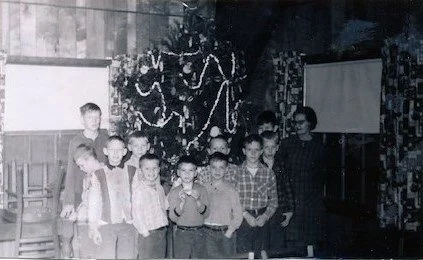
Boys putting up a Christmas tree at Drumm Farm. JCHS Image No. PHL 11777 Z
DRUMM FARM BOYS, CHRISTMAS, UNDATED
The Drumm Farm for Boys opened in what is now Independence in 1929.
Before his 1919 death at age 92, the retired cattle rancher and livestock entrepreneur Andrew Drumm had carefully planned the unique 370-acre facility where young boys in need could not only find a home but also learn agricultural skills.
The story goes that Drumm, while attending a winter benefit function to assist Kansas City’s young newspaper vendors, accepted an invitation to see a nearby newsboy residence.
It was, in fact, just an outdoor alley, where Drumm saw a crowd of newsboys sleeping in an alley during a blowing snow.
Drumm had spent many nights sleeping outside while driving cattle from post-Civil War Texas to Kansas railroad hubs such as Abilene, where the livestock clambered into rail cars headed for Kansas City meatpacking plants.
But the sight of children enduring the elements in this way rattled him.
“I will do what I can to remedy that,” he told his wife, Cordelia Green Drumm.
Together the Drumms travelled the country, visiting homes for neglected children and planning a rural farm refuge for Jackson County boys in need.
In 1912 Drumm signed his last will and testament in which he detailed the Jackson County facility for the care and education of children deemed orphaned or indigent.
The first boys arrived at the Drumm Farm in 1929.
They observed Christmas every year, and with Cordelia Drumm was involved in the festivities until her 1937 death at age 92.
Today the Drumm Farm Center for Children at 3210 S. Lee’s Summit Road in Independence operates as a foster care facility where licensed foster families live on-site, offering stable homes for children from infancy to age 18.
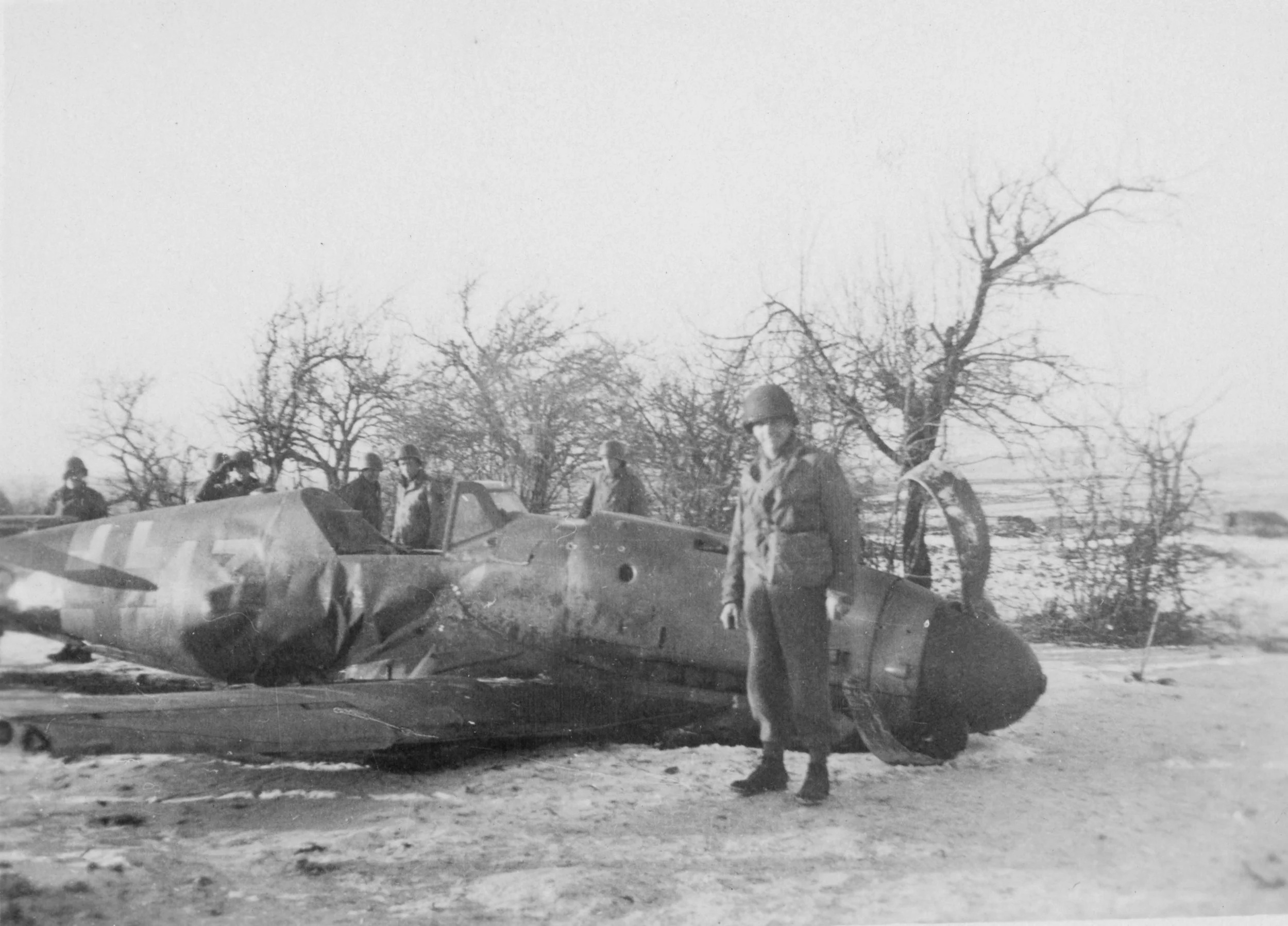
WWII photo. One of the Jan. air offensive (German) planes that didn't make it. Plane knocked down by our AA on Christmas Day. JCHS Image No. PHS 9215
GERMAN WARPLANE SHOT DOWN BY AMERICAN ANTI-AIRCRAFT BATTERY, CHRISTMAS DAY, 1944.
There is evidence of isolated unofficial Christmas ceasefires in 1944, during World War II.
The most well-known story is that of Elisabeth Vincken, a German mother who, with her 12-year-old son, sheltered both German and American soldiers on Christmas Eve at her cottage near the Belgium-German border and convinced them to place their weapons on the floor and sit down at her table.
German troops had launched a surprise offensive on December 16, sending some American troops back in retreat. During what became known as the Battle of the Bulge, three American soldiers, as well as four German soldiers, had become lost and separated from their respective units.
First the Americans and then the Germans knocked on Vincken’s door. Over the years her son Fritz vouched for the story’s authenticity, and today it is well worth seeking out online.
The Society’s digital database, meanwhile, contains this photograph that suggests how the bitter fighting continued everywhere else.
The notes with the photo are sparse, but it includes this: “Plane knocked down by our AA on Christmas Day.”
American troops in the battle would prevail by late January.
We don’t know where this picture was taken. American troops would not see peace on earth - or, at least peace in western Europe - until the May 8 German surrender.
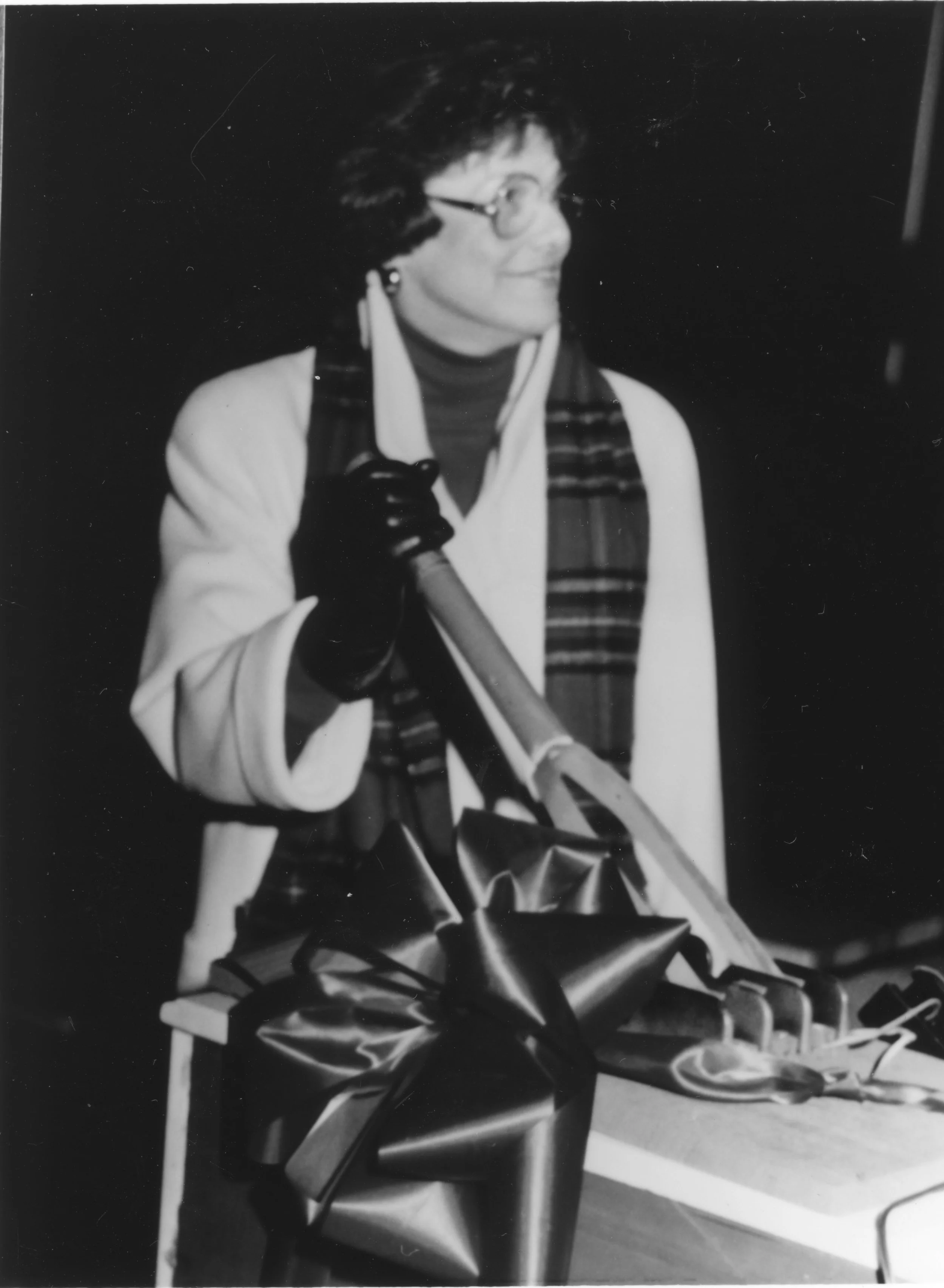
Barbara Potts, lighting the Mayor’s Christmas Tree. JCHS Image No. PHL 12664
BARBARA POTTS, MAYOR’S CHRISTMAS TREE LIGHTING, UNDATED
Sometime in the 1980s Barbara Potts, the first woman mayor of Independence, threw a mock over-sized electrical switch to light a Christmas tree on Independence Square.
Archival notes in our database insist this was the first “Mayor’s Christmas tree,” in Independence, which may have been true.
But Independence Square retailers had been observing Christmas since at least 1911.
That year the Maze Hardware Co at 116 S. Main St. advertised wagons and runners (wagons outfitted with runners for snowy days) at their store just southeast of the Jackson County Courthouse.
In 1920 the Allen Music Co., located on the square’s south side, urged husbands to “Be A Sport and Purchase a Grafonola for your wife this Christmas.” Grafonolas were early phonographs housed in handsome wooden cabinets.
In 1925 Knoepker’s Department Store, which opened on Independence Square in 1896, advertised a "Pre-Christmas Coat and Dress Sale” at “Special Prices for Quick Clearance.”
Potts began her public service career in 1978, when voters elected her to the Independence City Council.
She served as Independence mayor from 1982 through 1990.
It’s unclear when this photograph was taken, although evidence suggests it could have been 1984, as a separate photo of the same celebration depicts a lighted Christmas tree on the west lawn of the courthouse lawn, across North Liberty Street from the square’s Knoepler’s store, which closed that December.
Today the event can be seen in context of the challenges faced by Independence planners and developers, working to maintain the appeal of Independence Square given the opening of Blue Ridge Mall in 1958 and Independence Center in 1974.
Potts, following her two terms as mayor, in 1991 was named executive director of the Jackson County Historical Society and served for several years.
This photograph is from the Barbara Potts papers, donated to the Society in 2002.
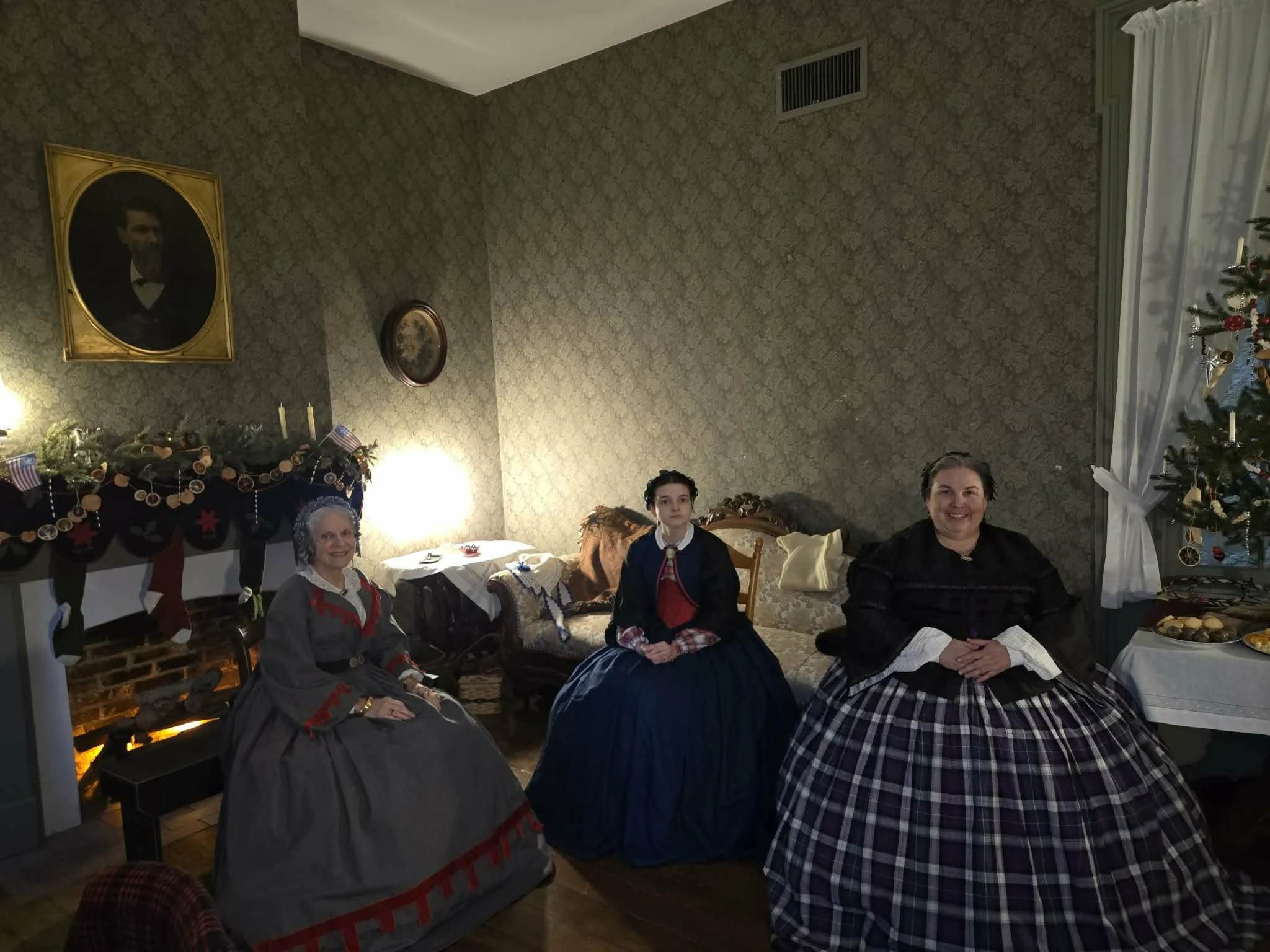
Living Windows, 2025. Image taken by Jason Wade.
LIVING WINDOWS, 1859 JAIL MUSEUM, 2025.
Okay, we’re cheating a little here.
There are several photos in the Society’s digital database that depict Christmas observances over the years at the 1859 Jail Museum at 217 N. Main St. in Independence.
Despite the name of the pre-Civil War lockup, the westernmost section of the structure served as a home to the families of the many marshals who operated the jail over the years.
We’re guessing they celebrated Christmas, too.
In recent years Society volunteers have donned period-appropriate apparel to present a reasonable facsimile of those 19th century observances as part of “Living Windows,” the annual holiday season promotion in and around Independence Square.
This photograph was taken December 5.
The recently-restored 1859 Jail Museum will close for the winter while staff members and volunteers prepare it for its spring reopening on April 1. That will include the Howard Schoolhouse, which workers recently lifted up and out of the jail courtyard to inspect and repair the structure’s foundation.
One of approximately 400 surviving one-room schoolhouses in the country, it is now back in place and will reopen to visitors this spring.
Until then, happy holidays from the Jackson County Historical Society.

Brian Burnes is former president of the Jackson County Historical Society.