
Audrey Stubbart: Prairie Proofreader
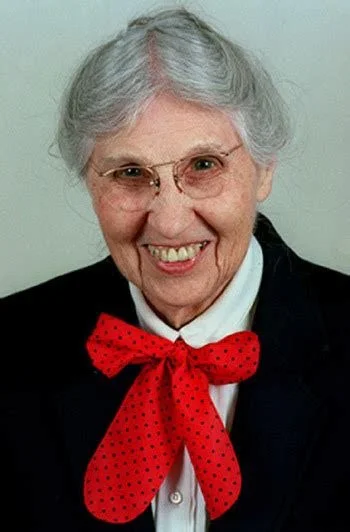
Audrey Stubbart
Sue Gentry interview of Audrey Morford Stubbart
This is a transcript of an oral history, originally taped and typed in 1990 when Audrey was 95.
Introduction
Audrey Stubbart was a good friend and an able, dedicated co-worker. She kept those of us in the newsroom of The Examiner in line.
Often, I would be at my desk, working away at a dozen things on deadline, when I would sense this certain presence. I’d look up, and there would be Audrey, dictionary in hand. She had a twinkle in her eye, but you knew you were in a certain sort of pleasant trouble.
“Come and let us reason together,” she would say.
Great conversation starter. It also meant there was about to be a brief debate about grammar, usage, or spelling, and you were about to lose. It was wonderful.
I’ve long known the outlines of Audrey’s story, but this conversation with another dear friend — Sue Gentry, who worked at The Examiner in some capacity for seven decades — highlights several themes.
One is how not just Audrey but her whole family valued education — lifelong learning.
Another, if I may borrow an observation from author David McCullough, is that we too easily overlook how hard life was not that long ago. Diseases that we’ve forgotten were very real dangers. Work was physical, relentless, and often dangerous. People scrambled to get by and maybe, just maybe, get ahead. A lot of people — Audrey was one — would pick up and start over again and again.
Audrey lived a long, long life and was often asked what the secret was. She told me the trick was to stay curious and keep learning. That’s still good advice.
Jeff Fox, Editor, The Examiner, Independence, Mo.
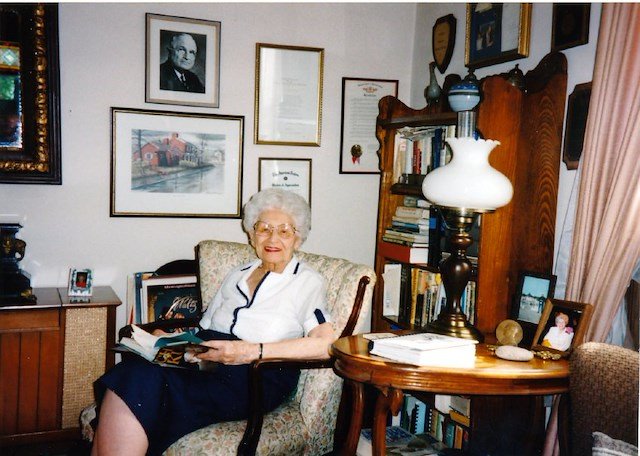
Sue Gentry
Sue: There we go.
Audrey: I was born in Newman Grove, Nebraska, and, uh, my husband was born just about 17 miles from where I was, but he was born five years earlier than (laughs) I was. Of course, my name is Audrey Morford Stubbart, and uh…
Sue: Morford Stubbart?
Audrey: Stubbart. S-t-u-b-b-a-r-t.
Sue: Okay.
Audrey: “T” on the end of it. Uh, my mother was, uh…well…I, this sounds egotistical, but I am proud of it, and I think that it has helped to, uh, move my life in a certain direction. She has common ancestors with the Queen of England.
Sue: Ah ha.
Audrey: And we always felt as though we should be a little more English and a little more precise than other people. It didn’t make any difference what other people did; you don’t do that sort of thing. And I think it’s good for children to have that kind of, well, they call it hero worship now, but it isn’t; it’s culture, loyalty, and I wish more people had it. I don’t know what would happen to the poor little kids that you’ve been talking about (Chuckle) if everybody was raised like that. My mother wouldn’t anymore let her play with a child that was illegitimate or anything that the parents had anything wrong with them — divorced or anything. We didn’t associate — she didn’t call it associate — she just said, “It isn’t nice.” So, I was raised rather strictly.
But my father died when I was seven, and had two brothers and another one that was born three months after he died. And mother raised her little sister that was 11 months older than I was, so that’s the only sister I had. But we were a happy family. And mother was a good manager, and after papa died out in Gordon, Nebraska, she used — she got $2,000 life insurance, and she used that to make a down payment on a farm homestead at Mason City, Nebraska. And we moved down to that, and she bought some cows and pigs, and had a separator and made a living and raised us kids on the farm until I was…well, she sent us back. Oh, there’s so much back there in my history back there that I won’t know what these things are all about.
Sue: Well, tell me. I’m interested.
Audrey: (Laughs) Well, my father was a …his name was Francis Orlando Morford, and when he was nine years old, there were so many children in the family. His mother had been married before, and was married to a Confederate soldier — and he was killed in the army in the war, so she married a, my grandfather (Laughs) and, uh, they were hard-working people, very hard-working people. Everybody had to get up and get a job. And when Papa was nine years old, he went to work for a neighbor or on a farm, and from then on, he was his own provider. And he went out to Nebraska then — this was Potawatomi County, Iowa.
He traveled around and went to work for different farmers. And when he was 26, he was in Nebraska, and met mother, and they got married. And mother was 21, and he was 26. And he died when he was 36, and they only had 10 years of married life, but they had four of us children, and they had lost a little — my oldest brother was born dead. So, the little girl that her mother had, just took her…his place. She was just 11 months older than I, and her mother died with cancer just — she had it when the baby was born. So they buried her, and Mother took the baby home and raised us all together. But she never let the little sister call her mother. She wanted her to know that she was her sister, and she always called her Etta. And I thought that was a little peculiar situation, but she wanted her children to know they were — they were all family together, and she wanted them to know the difference. She was a stickler for facts, and so, I guess maybe (Chuckle), that rubbed off a little bit too. (Laughs) All these things add up to make a — make you what you are, you know. You know that.
And we lived in Gordon, Nebraska, when Papa died. And her sister (Audrey’s mother) that had been, really stayed home and took care of her father and her younger brothers, she married at Christmastime that year. And her husband died with typhoid fever just a few weeks after my father died with pneumonia. And the two sisters were living in a house in Gordon, Nebraska, together. So, and then, their father died in just a few weeks, so they lost their husbands and their father there in just a little bit of time, and it…it…made them close, close together, and still they had to be farther apart because they had to get out and make their own livings. And my father is buried in Iowa. Let’s see…Malvern, Iowa, where his folks lived in Iowa. And on the farm up there in the central part of Nebraska, mother…schools were just almost non-existent, so mother sent us two girls back to Malvern to stay with my grandparents and go to school there. We were back there three years, I think, three different years, and she taught the boys at home.
And then she had a chance to sell the farm and buy a little place at Lamoni, Iowa. After, we were members of the, they were all members of the Reorganized Church of (Christ)…she was a member…none of the rest of the family were. And of course I was going to Malvern, uh…my grandfather was a Methodist, and my grandmother wasn’t anything. And she’d say, “I’ll get just as far to heaven as you will, Frank Morford.” (Laughs) And I expect she will. I expect she did.
Anyway, I went to the Methodist church there those three years that we were back there in school. But after we moved to Lamoni, I went to school there. And that’s where I met Dad (Audrey’s husband). I was 12, and he was 17, and so, uh…And we went to Lamoni to school, and I took up violin and played the violin in the orchestra, and it was nice, it was a nice time.
He shot his thumb off playing with a shotgun — shot his thumb and first finger — well (indicates thumb, first and little finger) these two fingers and his thumb off and so…uh. First time I saw him — he’s the…he’s the best-looking boy I had ever seen. I just couldn’t stand it. I just hurt so bad to see how good-looking he was (Laughs). I wish I had my pictures down; I’d show you some of them and you’d know.
But, uh…then the doctor told Mother that she had to get…into a…higher zone, altitude, because her respiratory — lungs, and so on, were not good there in Lamoni. That’s kind of damp and hot there in the summertime. So, she traded some (land) away — and I never did know how she found out — if I did, I’ve forgotten — down in the Ozark Mountains. There was someone down there, a woman whose husband had died, and she was looking for a place close to town to take her kin, and Mother was looking for a place out in the country, up in the mountains, so they just swapped places and (we) went down there. And I went to high school at Seymour, Missouri. And Dad (Audrey’s husband) came down. He couldn’t stand it.
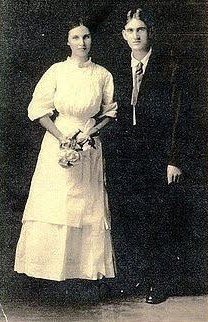
Audrey and her husband John were married February 1, 1911, in Tigres, MO. She was 16 and he nearly 20. They lived for a time in Iowa and then got a homestead out west (Utah or Wyoming) where they lived in a tent while building a 36’ x 24’ wood cabin. She says she had just 35 cents when she arrived there.
Well, Dad came down, and he liked it down there. And, uh…he wanted to get married. And so, talk about it, I was going on 16, and he was 20, so we just got married. And of course, I didn’t get to go to school anymore, then maybe that about broke my heart because I loved school. I just — I can’t pass a book. That’s the reason (Laughs) why I’ve got books all over the place. I’ll take you upstairs and show you some of them pretty soon. And he went up to northern Iowa, worked in ditching up there where they were draining sloughs to use the land for agricultural purposes. And he’d been up there the year before and the year before that. I went up to him then after we, after he got settled with a job at Sherwood.
Sue: Now, what year did you get married?
Audrey: 1911. That’s 79 years. Was 79 years last Thursday. And we had 54 years, and then he died before we had our…could go any further. But I thought that 54 was pretty good. (Audrey and John were married February 1, 1911, in Tigres, Missouri.)
Sue: I think so too.
Audrey: And a lot of people didn’t think that would last either. (Chuckles) But when…while we lived in Lamoni, I took violin for two or three years and played in the orchestra, and I love music. I still love music. I’ve got music (Chuckles) all over the place, But, if you don’t use it, you lose it so I don’t have…
So we went up to northern Iowa, and we were there, well, one year, and then I went back down to south Missouri, and our oldest daughter was born down there. She’s- let’s see- I was married in February, and she was born a year from the next October. And then he went back to Lamoni. His mother died, and he went back up to Lamoni for her funeral, and got a job, and stayed there. So I stayed with Mother until I went up after he got a job. After his mother was gone, they needed somebody there at the house to take care of his younger brother, so I went up, and then 19 months later, I had Veryl, my second child.
And we stayed there, and he was marshal, and night watch, and road supervisor. And his father was a missionary in the church, and he was in the church, and he was in the…the west…Utah and Wyoming. And they opened up a section out there — they called it resurvey. ‘Cause when they surveyed, they surveyed from east and from west, and where they met, they didn’t, uh, come out even, so they opened it up for a resurvey, and they opened it up for homesteading. So he (John’s father) wrote to John and wanted to know if he would like to come out and homestead. Said they could take 320 acres apiece and if they got right together, that would make them enough so they could run some cattle. So, here’s where my life starts. (Laughs heartily) This was another dispensation.
We got up and, just the two of us — here I had two little ones, and he left his job, and we went out. He went on an immigrant car. He took care of the stock for a couple of other people who were moving out, just to get our furniture in one end of the car, and he had his ride. I went down and spent about three months with Mother to tell her goodbye. And she said, (In a high-pitched voice) “Oh, my poor little girl, I’ll never see you again.” (Laughs) Well, I didn’t feel like that so much.
When I got out there, I had 35 cents left in my pocket. But…and he had a job at a sawmill where he was getting the lumber — taking his money out in lumber — to build the cabin for us. And we went over, and John’s father was there, and he both, borrowed a neighbor’s wagon, a light wagon, and we went out to look at the place. And drove up on it and he drove where he thought the house ought to stand, and he looked back, and he says, “Daughter, we’re really making our mark in the world.” (Laughs) Look back and see the wagon tracks, you know, the grass hadn’t raised up behind the wheel set. Well, we really made our mark in the world! (Laughs)
They (Audrey and her husband) put up a tent and borrowed from one of the neighbors who had moved out ahead and lived in the tent until they got their house built. And he put the tent up and put the corral around it so the cattle couldn’t get to it. Set up a stove outside the tent. And I stayed there from August ‘till Thanksgiving time. Kept the children out there on the prairie. I said, two-o-o — that’s just how much sense kids had at that time and still have. Go out there and drive down four stakes and say, “I’m going to make a living for my family right here on this, this piece of ground.” Well, what kind of idiocy is this?
There was a nice little branch of water ran through it. It had a lot of sinkholes in it, and cattle would get down in it. We didn’t have anything! Not anything! The neighbors came, and they had a log-raising and raised us the…a nice little, oh, just 36’ x 24’, had two nice big rooms in it. He got the lumber and got the flooring in it. And when the, the day before Thanksgiving, we moved from the tent into this new house. Oh, I can smell that pine yet! It smells so good. And that tar paper. Even tar paper smells good. And the door!
They just built the door like this (indicates with hands) and then put the, one of those latches in the slot so you had a string through it. And when the string is outside, you can lift it — you know how they were. When you’re in the house, you can pull the string through the hole inside the house, and then there can’t anybody get in.
And when we moved in there the day before Thanksgiving, and it was our house, and our stove, and our bed! When I saw my barrel of dishes with my dish towels in them, I just took them out and held them up, and cried. They were mine! This was mine!
Well, it was a pretty tough winter. We’d taken — I’d taken some things out. Barrels of food. We were 35-50 miles from town, and up on top of the hill was a store, and that was about 17-14-15-16 miles from where our house was. And they had to have their stuff for the store trucked out from town.
And John rented — hired a team and wagon from the neighbors — and he’d go in and take three days to go to town, load up, and drive back because he couldn’t drive all the way, and got what groceries he could that way.
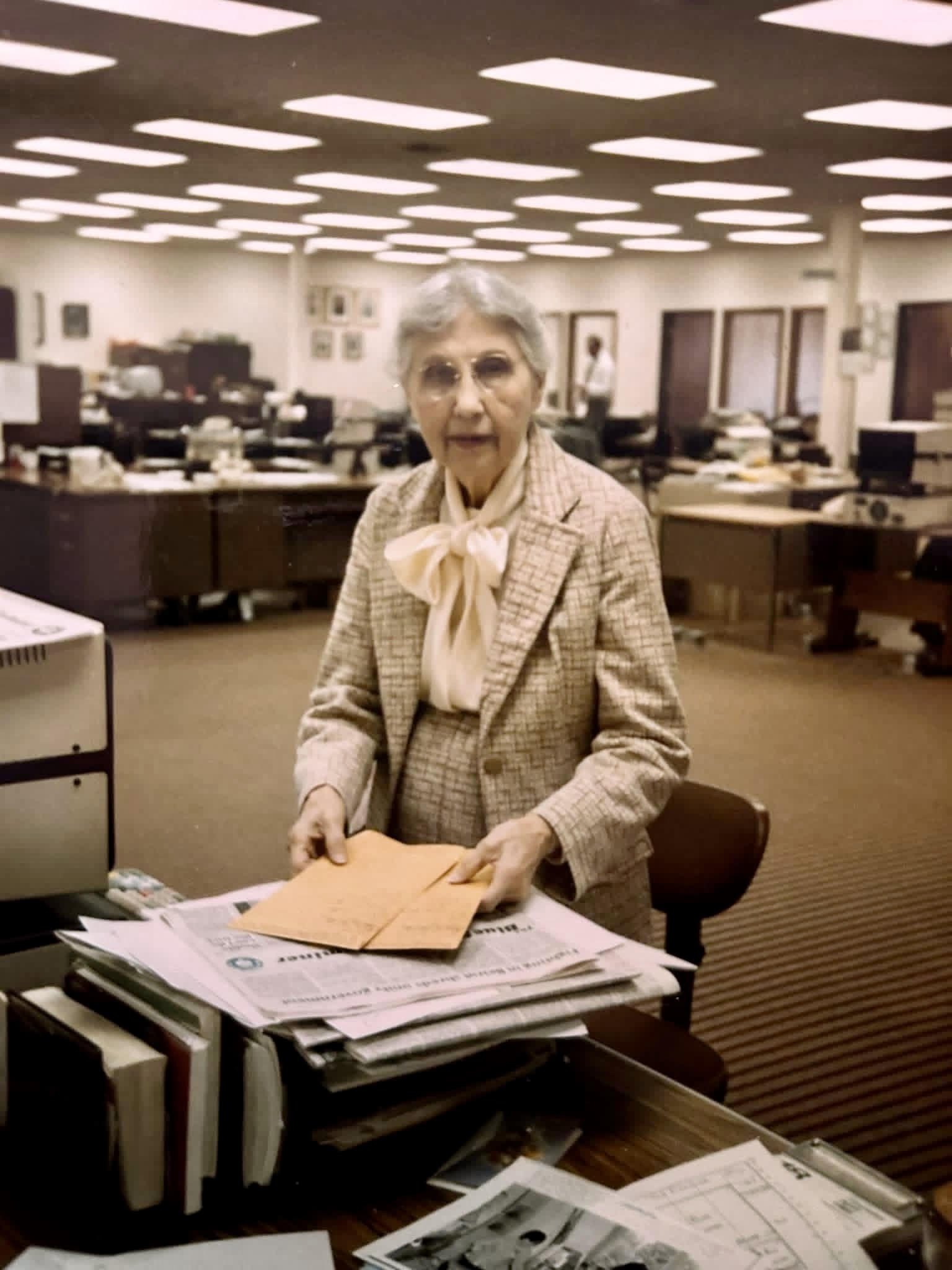
“Come let us reason together,” current Examiner editor Jeff Fox said was Audrey’s gentle way of telling an Examiner reporter that there were mistakes in their story which needed addressing. She is pictured here in the Examiner newsroom sometime in the late 1980s.
So we didn’t starve, but we got awful hungry sometimes. (Chuckles) And no milk. I had two little kids that weren’t very well, and they needed it. Veryl had - the doctor called it “brain fever”; we never did know exactly what it was while I was down at mother’s. And he had to have food. He’d get so hungry, and he’d say, “Beans, beans.” And that’s where he got the nickname “Beany.” (Chuckles)
And my little daughter, when she was born, she scratched — we were down at south Missouri then — she scratched her eye in the corner. She was born out in the country, and (the) doctor came out. I don’t know…she says that mother told her that the midwife wouldn’t clean her fingernails. Thought that if you clipped their fingernails, that it would make thieves out of them. Now she was a Swedish lady, and I don’t know how much of that. I didn’t remember about it, but anyway, she did it (scratched the baby’s eye), and infection set in and it ate a hole clear across like this (indicates left side of face to nose) down through her nose and ate the bridge out of her nose. So she’s always had a little facial disfiguration. But everybody that sees her loves her, and say they never think about it after they get acquainted with her.
So I had the two little children out there without any milk and not always bread. But, one of the, uh, you haven’t time to listen to all this.
Sue: Certainly, I do.
Audrey: What has this got to do with…
Sue: This is history.
Audrey: Us living?
Sue: This is history, Audrey.
Audrey: This is history, I guess. That’s what the children say. Why don’t you write that all down? We’ll never know what it was like.
Well, the first year, when we got there, one of the cowpunchers had made him a claim, got his claim and he got some chickens and set an old hen on some eggs. And he brought the hen and the little chickens to me. That was their welcoming, their housewarming — so we had that much meat, the chickens. And we had beans, and beans, and beans. (Laughs) And I had a few jars of fruit.
Didn’t have much sugar. I remember one day when…uh…I thought it was sugar, and it was salt. And I made some cinnamon rolls. Oh, we just couldn’t wait to get them baked. And then (Chuckles) oh, and I had to throw out all that bread because oh, (Laughs) it was so salty, couldn’t anybody eat it.
Well, where do we go from here?
They needed a school teacher, and I loved school so much, and I had taken all of — John’s father was a school teacher — and while we were there, he gave me his library. And I took all the books with me, so I had a lot of time to study. Nothing else to do but stay in the house and take care of the two little kids. It was too cold to go outside. And I just studied. I just…uh…just made a curriculum of my own and studied. And then they opened up the teacher’s examinations; anybody could go take them if they’d had (gone through) the eighth grade. So I went over and took the examinations, and got my teacher’s certificate, and started teaching school. And I taught for seven years.
And Dad (Audrey’s husband) would go down to Nebraska and work in the sugar beet field and get money that way for us to live on. And, his father inherited some money from his mother, grandmother, no, his mother. So he got a few head of stock. Got some (inaudible), cattle, horses, and we began to get the ranch, and John paid for some tax, taxes that were, were due and they hadn’t paid out on them. Got another 320 (acres) and took a timber claim. And he got 320, and when we left there, we had 2,100 acres of land. And then we came out here, and of course, we have two acres here (Editor’s note: White House on 23rd Street just west of what is now HyVee), and they’d say, “Oh, who owns all that land there? And well, it looks awful little to me compared to 2,100 acres. (Laughs)
And he got some sheep, and we went into the sheep business. Then the army took the boys. And, and Enid married a school teacher.
(Editor’s note: Audrey may be talking here about her daughter who had a facial injury.) She — oh, way back there, I took her back to when school started, a state nurse came out, and she said, “If you don’t put her under a doctor’s care, we’ll take her away from you and put her where she can have care. She didn’t realize that the nose, couldn’t, couldn’t anything be done for her nose. And so I brought her back here to Mother’s, and she was in Children’s Mercy Hospital, back and forth. They’d take — Mother’d take her back and forth. I went back to the ranch. Had another little boy by that time. Oh, I have children, five children, by the way. Three boys and two girls.
Sue: Now that, list their names and…
Audrey: My oldest one is Enid, and she’s DeBarthe now. And the next one was Veryl Winston. He lives in Wyoming. Enid lives in Iowa. And Donald was born seven years later. And he was a bomber pilot, by the way. He lives in Cordova, Illinois, now. And eight years later, I had Carol. She lives next door to me. And Donald said, when Carol was born, he said, “Now don’t you raise her alone like you did me; you get to work and have another one.”
Sue: (Laughs)
Audrey: So we did. We minded him. So we had Kenneth then. And he lives in Columbus, Ohio. Uh…we come from a family of school teachers, I told you. My great-great-aunt founded the first co-ed college. Mary (pause) Oh, I thought I’d never forget…forget the name. Her name was Mary Lyon, and it’s Mt. Holyoke College. And she founded that. So, we’re kinda special to — for — by school teachers.
Sue: Yes.
Audrey: (Laughing) And John’s father and relatives were school teachers too. So, it kind of runs in the family. We are all of us book-inclined. Well, after the war broke out, and, uh…
Sue: Now, which war is that?
Audrey: This is…uh, well, the First World War, we went out to Wyoming in 1916 and then, you know, when the war, first war broke out — in 1914. But we didn’t get into it until 1916. So we lived through the First World War. And then the Second World War in ‘44, and Donald (son) went into the Air Corps and the two younger kids had to have high school, and there we were, 25-60 miles away from a high school.
And John had ruptured himself so badly building the new, big new barn, and uh…I said, why don’t we just sell and go home? Why don’t we go back to Missouri? Why don’t we sell out? Why don’t we sell out? And I played that tune so hard and long and heavy-footed.
John came in one day and said, “Well, honey, I’ve sold the place.” Why, you what? (In a high-pitched voice). You sold my home? Oh, oh, oh (makes crying sounds), and I cried and cried. “Well,” he said, “Damed if you do and damed if you don’t. You’ve been wanting us to sell it, and now I’ve sold it, and now you’re mad about it.”
Well, I said, what’ll we do? He wasn’t able to work. And he didn’t know anything about working in town except when he worked for the…Lamoni…for city work. So he said we’d have the sale. I had an organ and piano. We’d always had a little orchestra at home. Enid had the ukulele and, uh, we got the little fellow a drum because he didn’t want to sit there and do nothing. He wanted to play too, so we got him a drum. And he’d get so enthusiastic about beating time to that drum, he (laughing) just took the drumsticks like this (demonstrates holding sticks) and poked them right through the top of that drum. Oh dear, we had a good time though.
But Enid had…uh… stayed here (Missouri) with Mother and graduated, then got her teaching diploma and then came back out to Wyoming and taught school and met her husband out there. And he was a school teacher too. And his mother was a school teacher. So, they got married and went back to…well…they left home. And Veryl came back here to Graceland and then came down here and met, uh…Enid’s friend, Hazel Hartman. She was a trained nurse, and they got married. So they were gone. And then Donald joined the Air Force when the war broke out. Then we had the two younger kids, eight years younger, at home. And they had to have schooling, so we just sold out and moved back here.
And John says, “I’ve got to go deer hunting once more before we leave the country. You take the kids and go on back, and I’ll go hunting once, and when I get my deer, I’ll come back.”
So we moved back; this was about the 17th of October. And I…this place came up for sale, and I said, what do you think about it to my brother. And he said, “Well, I know the woman that’s selling it, and I know the place. Let’s go out and look at it.” So we came out and looked at it, and Kenneth says, “I’ll try to see if I can get her to cut the price a little bit.” No, she wouldn’t. She wanted 65…$6,500 for it. Two acres and two houses. I said, I believe I better buy it. That won’t last very long; I think I better buy it. So, I had the checkbook and the money in the bank to make the down payment on it, and I bought it. And when John came, I told him what I had done. “Now what have you done?” He planned on buying a little farm.
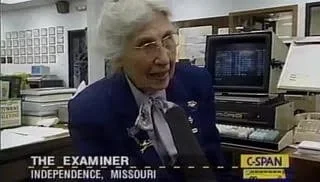
Audrey developed a large following on the world stage with reporters from national media coming to interview her for her 100th birthday.
Well, in the winter, that winter, an opening came in the Herald Book Shop (at what was the Reorganized Church of Latter Day Saints and is now Community of Christ) for a proofreader, and that was right up my line. So I went up and… well, I didn’t go first. Gene McKeany was a foreman there, he said, “Send her up. I know her.” Well, I went in and applied for it, and he came in and said, “I know her.” So he put me right to work. Well, I worked there for 18 years, and by that time, I was too old, so they retired me. And I was 66. And they needed a proofreader over at The Examiner. So they…the editor, City Editor…came and interviewed me and watched me work a little while and said come on down. And I had three more days there, so I went down there, and I’ve been at The Examiner ever since. And that’s going on 29 years (Editor’s note: This puts Audrey at 95 years at the time of this interview. To celebrate her 100th birthday, The Examiner hosted a reception for her at the now-closed National Frontier Trails Center, and she stood to personally greet the more than 300 people who came to wish her a happy birthday. Audrey worked at The Examiner until she was 105.)
Sue: (Laughs)
Audrey: And you don’t know a thing about learning to ride horseback and teaching school and riding, uh, eight to 12 miles every day to school and home again.
You don’t know anything about my youngest son almost drowning. He fell in the…We didn’t have enough tubs, so I used an eight-gallon jar for rinse water. And we had to carry the water so far that I’d just set it outside, and then they’d just take it out and dump it on the garden where it needed the moisture, you know. I was ironing, and he was out in the yard.
I looked out the window every little while I was ironing, and I could see him playing out there. I thought everything was perfectly safe. And I went finally, and I didn’t see him anywhere, so I went to the door, and here his little feet were sticking up out of this eight-gallon jar of water. And I pulled him out and started screaming just as loud as I could. And the menfolk were out in the field and with the sheep. They heard me, and they came tearing down, and they laid him down.
The oldest son had been taking some…uh…survival of some kind in high school in Moorcroft (Wyoming), and he and his dad worked with him. They worked with him 40 minutes before he breathed. And the doctor said, “Why did you stay with it so long?” So we just stayed with it, and he started breathing, and he…soapy water ran out of his mouth. And we cried and cried. And we went to bed. John was crying too, and I said what are you crying for? You’re not his mother. He said, “People don’t realize that fathers love their children just as much as their mothers do. And we cried some more and cried together.
Well, the only thing now that he has is, uh…a scar on his lungs. The doctor says that must have been what caused it. But his mind is in good shape. He’s taught school for 34 years. He’s retired now. All the kids are retired but me (Chuckles), and I don’t want to retire. Not Ever! (Laughs) Oh dear, you don’t want to hear any more, do you?
Sue: Well, actually, I do. What…I know, besides all the…besides proofreading and all that, I know you have hobbies. And I’m aware of some of them, but tell me what they are for the tape (interview).
Audrey: Oh, I, one hobby is writing my column for the paper, and I love to do that. But I, uh…make quilts and crochet, and do that sort of thing. And I love working in my garden. And I think…well, somebody said at church one day, “You must have found the fountain of youth out there in your garden, ‘cause you never get any older.” Well, I do think working in the garden has had a lot to do with it. I’ll be 95 in June and, and I think I can — I know I can walk the kids to death because we just got back from Scotland and Ireland and Wales and England, and when we got back, Enid had to have a pacemaker put in, and I went to work (chuckles) the next day and never missed, never missed a day. I just don’t; I don’t know.
Sue: Describe the clothing you wore when you were out… Well, when you were out in Wyoming homesteading. What clothing did you wear?
Audrey: Well, I tell you, we didn’t have an awful lot of clothing. I think we had two or three dresses apiece. And I wore mine and carried the children on my hips, and my hip bones stuck out so hard that that’s the (laughs) first place I’d wear them out was over my hips. My skirts would just get threadbare. I tell ya’ I wore overalls — not jeans, but overalls — bib overalls. And I said, I’ll never wear overalls again when I get away from the farm. And I don’t wear jeans yet. I don’t enjoy that kind of clothes.
So. And, when I went to summer school, summers, mother would always buy or make me something that I could wear that was fit to wear. I went to summer school in Arvada, Spearfish, and Moorcroft and two or three other places around there… Sundance. We’d go to summer school to keep our certificates going and add credits to our standing, which was nice. And keeping the children and clothes was a little bit of a task. The relatives back here would send me clothes that I’d make over for the children. I made their coats, and blouses and skirts and pants and overalls, everything else. That wasn’t a hobby; that was a necessity. (Laughs)
And I like to tat (making a type of lace). And I like to crochet, and I made a — I have a kind of little hobby, uh… every time I hear some of the family or some of the church family (are) going to have a baby. I get busy and get an Afghan started for them. I’ve got one running now, but, but oh, they’re out of the kind of yarn, so I can’t finish it. Oh, I wish you’d turn that off, and I could just, huh, ha, ha. I don’t like to talk about myself. One of my granddaughters called the other day and wanted to interview me for her class at school. And she said, “But grandmother, haven’t you done anything else, haven’t you done…?” Well, I don’t want to brag about that. “Well, you’re just too modest. I’ve got to know what (Laughs) what you’ve done all your life.” (Laughs) Oh dear. I rode horseback; I herded sheep; I pitched hay (laughs); I rode the cultivator and cultivated the corn, and I canned food, and I don’t know what all I didn’t do. Turn it (recording machine) off. (Laughs)
I didn’t tell you about the babies I had helped into the world and the two that died. John made these little coffins, and I laid them out and sang at their funerals. We were too far from a funeral home, so I laid out some older ones too. And I sang and sang because there was no one to hear and criticize. This sounds awfully crude and illiterate!