Kansas City's Arabia Steamboat Museum to Close November 30
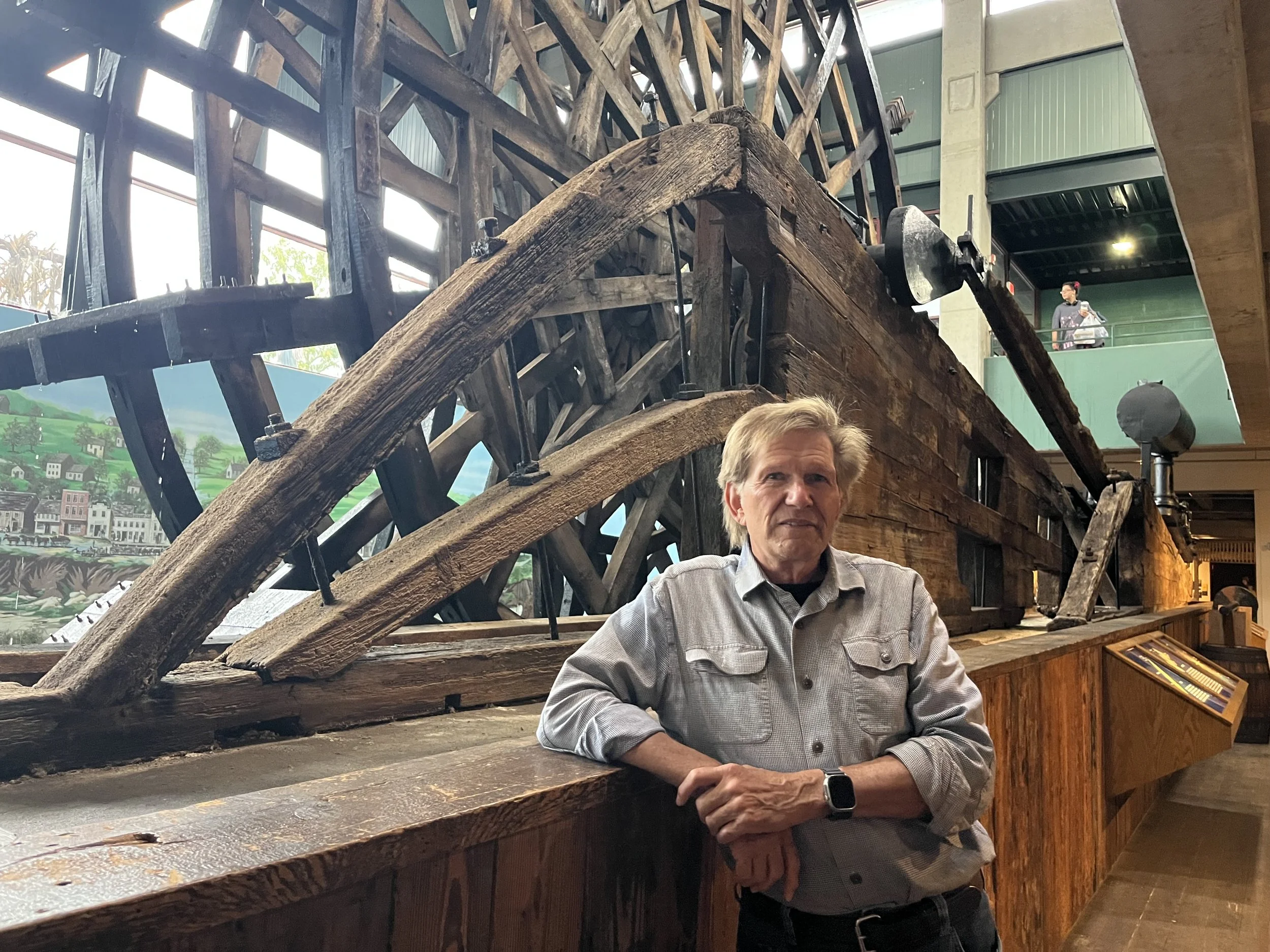
David Hawley, Arabia Steamboat Museum director, with four other partners, opened the museum in Kansas City’s River Market district in 1991. Photo courtesy of the Jackson County Historical Society.
While St. Joseph, Mo., may be its new home, that has yet to be finalized, said museum director and co-owner David Hawley.
The Steamboat Arabia Museum, a fixture in Kansas City’s River Market district since 1991, will be closing November 30, museum director and co-owner David Hawley has confirmed.
Kansas City has chosen not to renew the museum’s lease, Hawley said.
After November 30, museum staff will have six months to take down the exhibits and vacate the building at 400 South Grand Blvd.
While he long has been meeting with St. Joseph, Mo. economic development officials, Hawley would not say whether the museum is headed there or any of the several other Missouri River communities such as Leavenworth, KS or St. Charles, MO, whose officials he has met with in recent years.
“It’s not a done deal,” he said. Still, he added, “If this whole thing was a horse race, I would say that the St. Joe pony is in the lead.”
While he added that he always will have fond memories of the River Market location, a larger facility could offer opportunities the current space could not.
For years Hawley has been considering a possible excavation of the Malta, a steamboat that sank in 1841 near what is now Malta Bend, in Saline County, about 85 miles east of Kansas City.
If the museum kept operating at its current location, he said, he never would have room for all the artifacts he likely would retrieve from the Malta.
Hawley also envisions that the materials recovered from a second steamboat would be exhibited in a repository rebranded as the National Steamboat Museum, which would detail how America’s steamboat era helped open the American West.
“If you add another boat into the mix, you can’t call it the Arabia Steamboat Museum anymore,” he said. “Because you’ll have two boats then, and it was a national story. Boats were being built back east in Pennsylvania and all along the Ohio River.
“They built ‘em out east and we sank ‘em out west.”
In an interview with the Jackson County Historical Society, Hawley discussed how he became one of five members of a salvage team that in the late 1980s recovered more than 200 tons of 19th century frontier merchandise from the Arabia, which sank in 1856 near Parkville.
“Truthfully, I just feel that this is meant to be,” Hawley said of the Arabia museum’s impending departure from Kansas City.
“I’d like to dig another boat, I have for years - and the Malta, when it sank, was on its way to St. Joe.”
By Brian Burnes
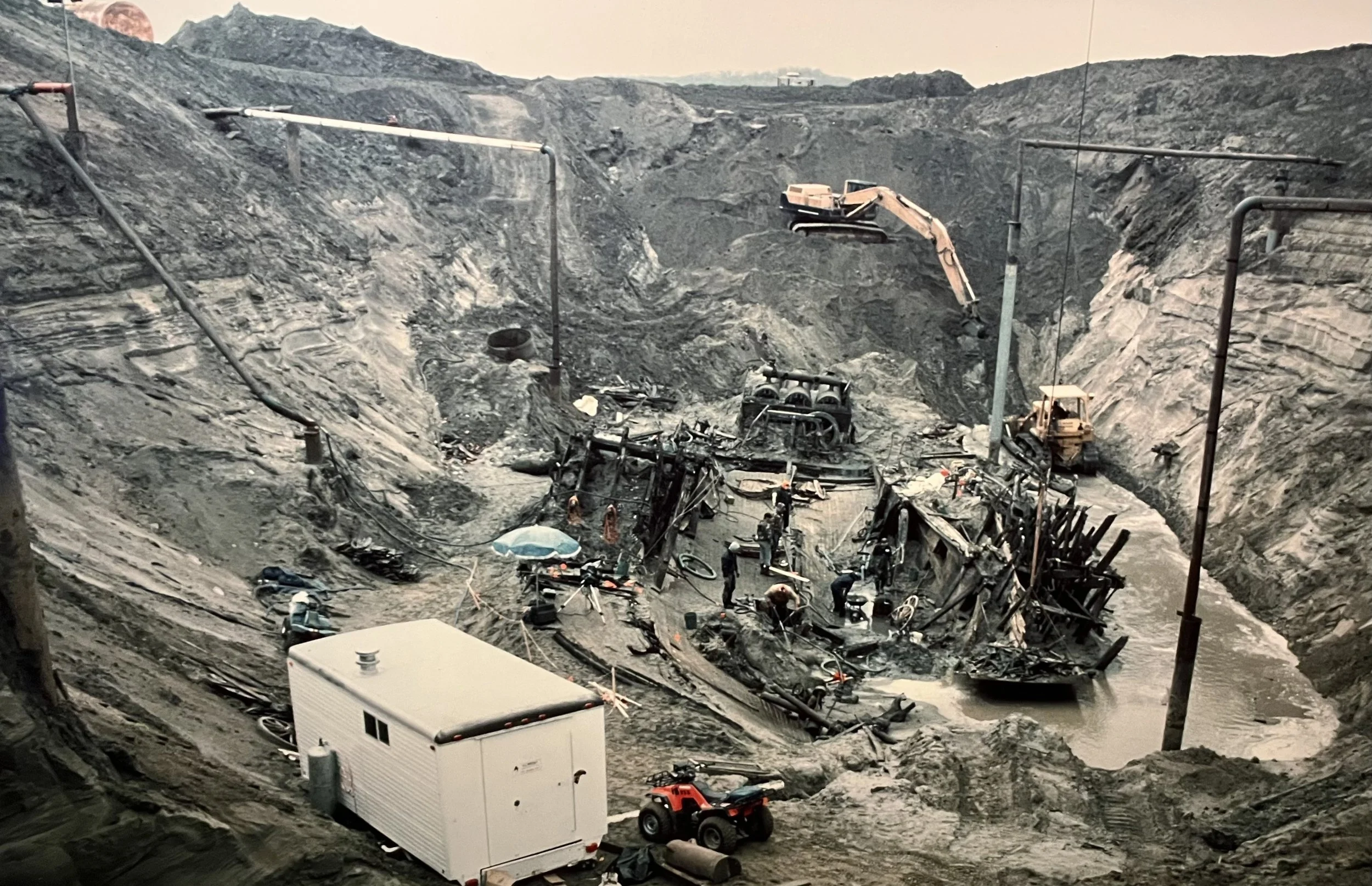
The Arabia Steamboat team found the sunken vessel 45 feet below the surface of a Wyandotte County farm field. Photo courtesy of the Arabia Steamboat Museum.
In his steamboat digging career, Hawley has helped excavate two boats, the Missouri Packet, which sank in 1820 near Boonville, about 100 miles east of Kansas City, and the Arabia.
He has confirmed the location of 10 others.
As Hawley tells it, it all started one day back in about 1985 when he - representing the family’s heating and air conditioning business - answered a service call in the Susquehanna district of Independence.
It didn’t take long to fix the customer’s central air. But then he invited Hawley into his converted garage.
Flying saucers and aliens covered one wall.
A floor-to-ceiling picture of Bigfoot, or Sasquatch, covered another.
The third wall was devoted to sunken steamboats, and various efforts to unearth them and their cargo.
“So he started telling me about all of these things,” Hawley said recently.
“But I wasn’t into Bigfoot or flying saucers.”
But he suddenly was very much into sunken steamboats.
His enthusiasm impressed his father Harland “Bob” Hawley and David’s brother Greg, as well as two additional partners who together, in 1987, established River Salvage Inc.
The following year the group uncovered the Arabia and began recovering its cargo buried 45 feet beneath the surface of a Wyandotte County cornfield.
Although Hawley and his partners had not initially planned to open a museum displaying the artifacts, that’s what they did in 1991. In its first year of operation some 200,000 paying customers showed up.
Historians, meanwhile, were dazzled.
The Arabia team, said Andy Masich, president of the Senator John Heinz History Center in Pittsburgh, Pa., had “amazed the world with the largest cache of 19th century material culture ever discovered anywhere.” The Arabia collection, two-time Pulitzer Prize winning author David McCullough once said, represented “the best small historical museum in America.”
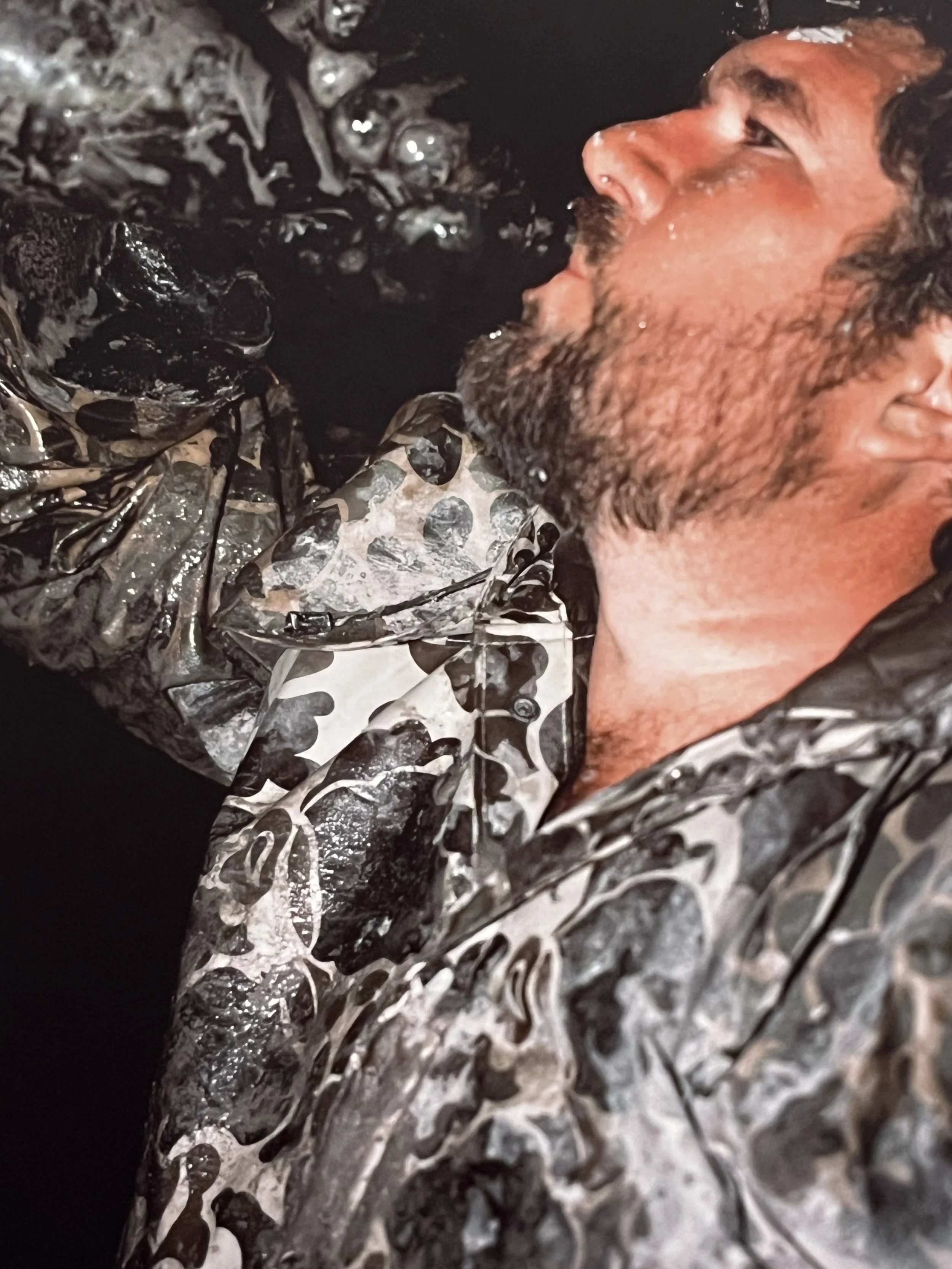
Crew members of the Arabia digging team toasted their discovery of the ship’s cargo, some of which included cognac and champagne. Photo courtesy of the Arabia Steamboat Museum.
It’s been a remarkable story, Hawley said.
“If you talk to some museum people about how some air conditioning and heating guys would go out and dig up a steamboat, and then also figure out a way to preserve and display the artifacts from that steamboat, and then operate a museum featuring these artifacts for 35 years - well, that’s pretty unique.”
An expensive adventure
Q. You describe how - after visiting the Bigfoot, flying saucer and sunken steamboat garage - you told your father to meet you at an Independence HiBoy restaurant. Jerry Mackey, founder of the HiBoy hamburger restaurant group, was there that day and soon joined the two of you at the table. At some point, your brother Greg showed up, too.
I think I told the story three times, By the end of lunch said, Dad said, “You go find a steamboat and we’ll help you dig it.”
Q. The original group included you, your father, your brother Greg and Mackey. You later acquired a fifth partner, David Luttrell, a construction business owner.
A. He was the only one of us who had a bulldozer, so he was in. Our bookkeeper said ‘This sounds like a big adventure, but keep everything separate from your heating and air conditioning business.’
Q. One of your first stops was the Mid-Continent Library on U.S. 24 in Independence. Soon after that you went to Columbia, MO., home of the Missouri Historical Society and its Western History Manuscript Collection.
A. I was in one library or another for a long time, studying about steamboats. I learned about the Arabia and the 60-ton, 120-foot long Missouri Packet, which sank in 1820 near Boonville while on its way to provide provisions for U.S. soldiers stationed at Council Bluffs, Iowa. It’s considered the first steamboat to sink in the Missouri River.
Q. At some point you acquired a magnetometer - an instrument used to measure the strength and direction of a magnetic field - and you confirmed the location of the Packet. You started digging in late 1987 and you retrieved the boat’s 5,000-pound steam engine. That’s on display today in the Arabia Steamboat Museum and is thought to be the oldest surviving maritime steam engine of the United States. But there virtually was no cargo to collect.
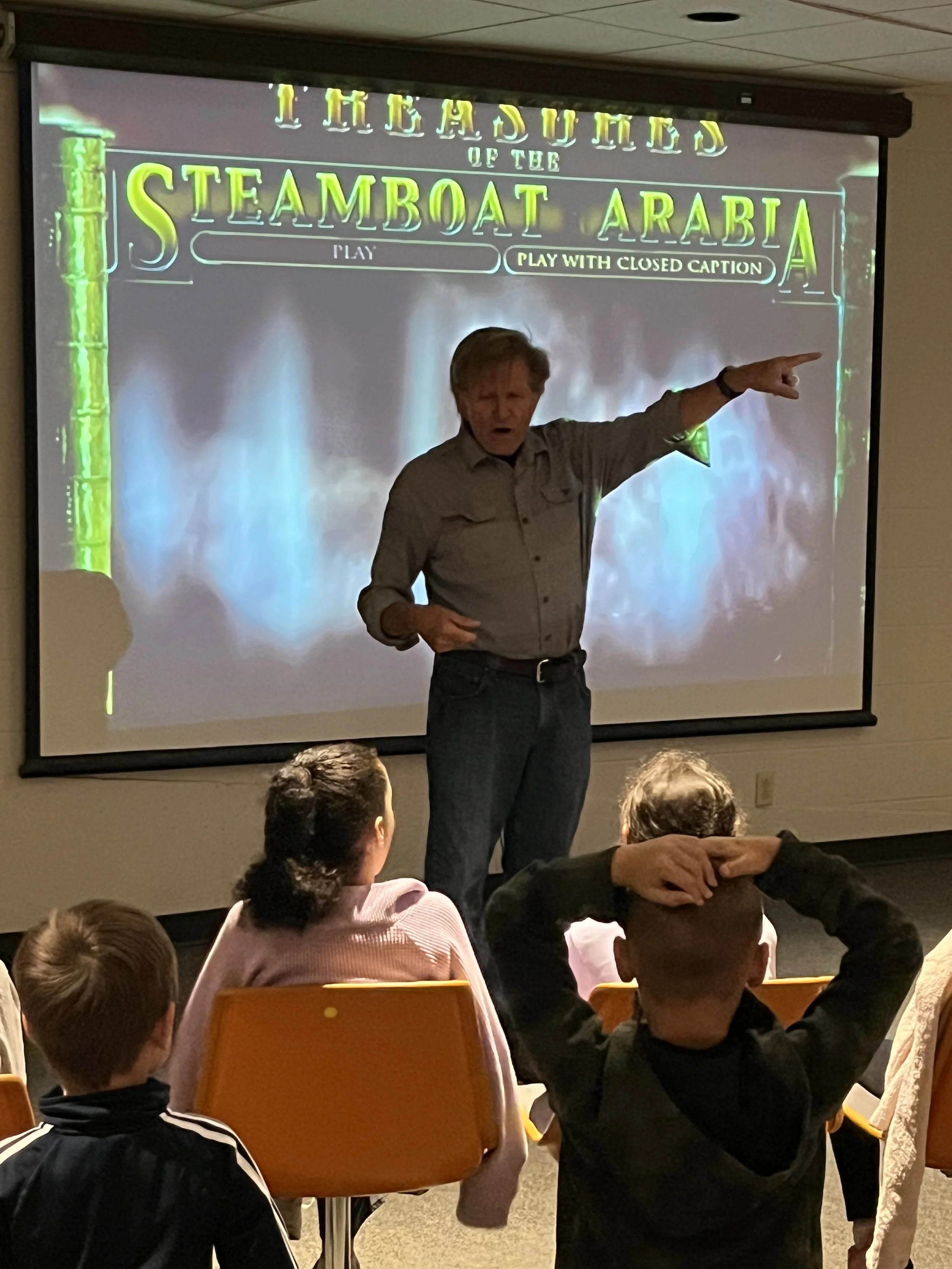
Today the museum attracts an average of 75,000 visitors a year, and David Hawley often addresses tour and school groups. Photo courtesy of the Jackson County Historical Society.
A. Steamboats back then didn’t look like the Arabia; they didn’t have the upper deck. It was more like a barge. The boat had a double hull, but you didn’t need that on the Missouri River. So you had this hugely heavy boat with this really thick planking on it with an underpowered engine on a really fast river. It was not a good combination so the boat sank and virtually everything was washed away.
Q. That was in the spring of 1987. Later that year you turned your attention to the Arabia, which newspapers at the time reported as having a “large and valuable cargo.” Today you estimate that digging up the Packet cost about $125,000, with the Arabia costing about $1 million.
A. When we began on the Arabia we weren’t thinking we were going to spend $1 million. We thought ‘This won’t cost us very much.’ We thought maybe we would be spending $50,000 to $60,000. Or maybe $100,000. I think what we were looking for was adventure. But If we had known that we were going to spend about $1 million to dig this boat, I think the group would have said ’That’s kind of an expensive adventure.’
Q. It sounds like an example of the “sunken cost” theory - in this case the word “sunken” being literally the case.
You’re halfway through and you’ve spent all that you have invested. So you could quit - but you can’t quit now. Maybe there’s a box of gold down there, and if you quit you’ll go the rest of your life wondering about that.
Finding cool things
Q. So you began digging the Arabia in a Wyandotte County farm field in late 1988, and during the subsequent months, you began finding authentic 19th century artifacts. How did the idea of a museum take shape?
A. We were thinking we would find some cool things, and that it wouldn’t cost us very much and we could quit at any time. But we kept digging and kept finding cool things. Somebody would find something, hold it up and say something like “This looks like something I’ve seen in a museum.”
And then time would go by and somebody else would find some really cool thing and say “This would be a very cool thing for a museum.”
And then finally somebody would say “Now, when we get our museum up and going, this will be a very cool thing to display.”
So it was a very organic process and so by the end of the day the conversation became “So how are we going to set up our museum?”
Q. But there was a lot of work just getting to that point. Readers of your 1995 book, “Treasures of the Steamboat Arabia,” can read about how you brought the heavy equipment necessary up the Missouri River to the Wyandotte County farm field. The search began on Nov. 7, 1988. The Arabia team placed 20 pumps powered by diesel generators that dispersed water to lower the water table sufficiently to allow access to the Arabia, 45 feet below the surface. Your first find, on November 30, was a rubber shoe.
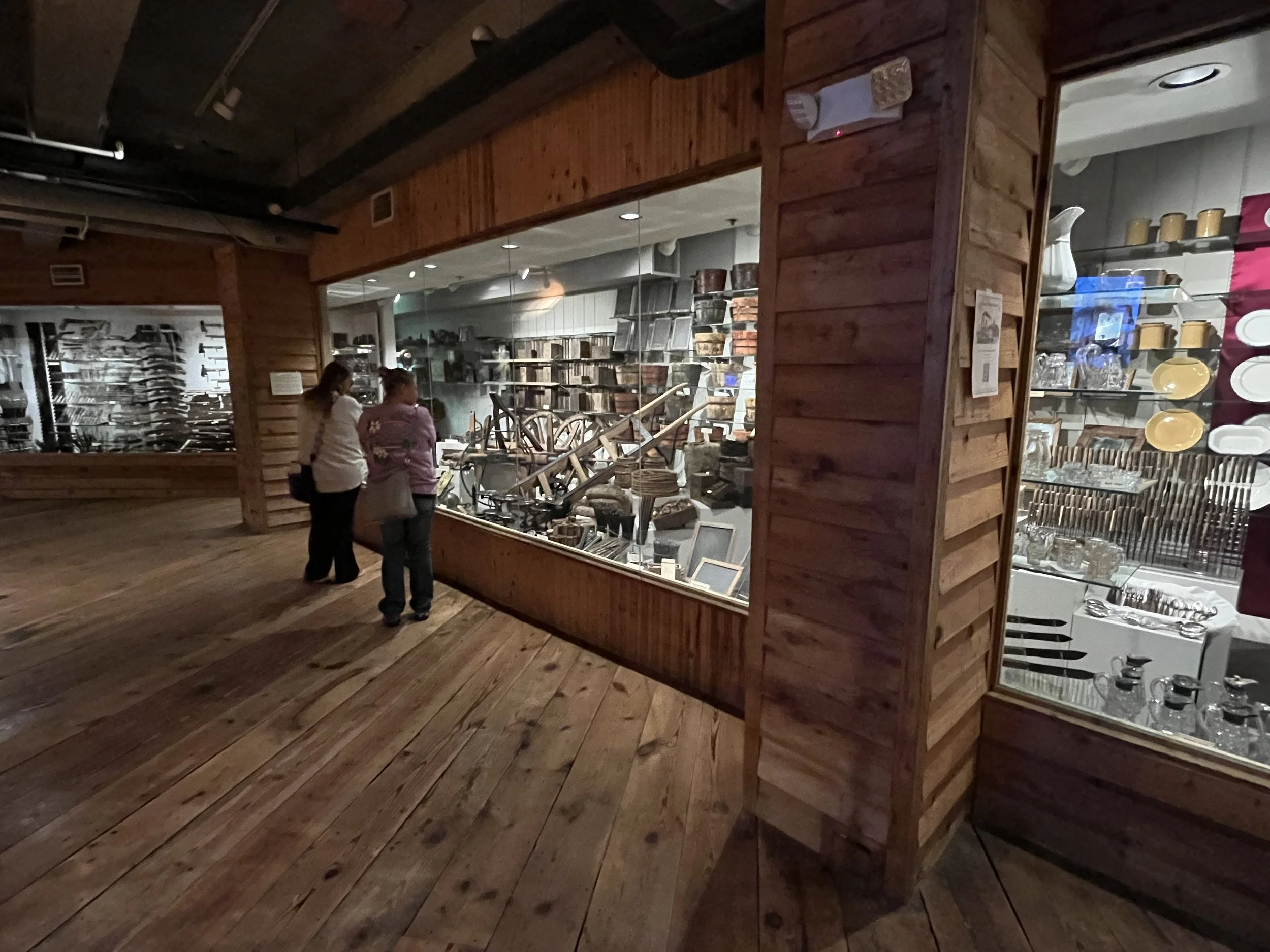
Museum visitors, according to David Hawley, routinely remark upon the sheer volume of frontier merchandise headed west on the Arabia. Photo courtesy of the Jackson County Historical Society.
Over the next three some months, workers brought up a remarkable array of frontier merchandise both basic and fancy. The former included building supplies for the settlers, such as door knobs, locks and latches. Items in the latter category included cases of gin, cognac and champagne.
There also was European dishware, iron ax heads, children’s boots, flintlock rifles, cherry and blueberry pie fillings, and coffee beans.
Then there was the challenge of stabilizing the artifacts recovered. Leather goods were cleaned with water and frozen in blocks of ice to stall deterioration, while bottled food items were stored in a large commercial walk-in cooler. When and how did all this work get done?
A. We lived in independence, so we would leave the dig site at about 7 p.m. It would take us about an hour on Interstate 70 to get back to Independence. Jerry Mackey at the time had a building on Noland Road right behind one of his HiBoy restaurants, and we would work there until about midnight.
The next morning would begin at 6 a.m. when we would begin doing service calls for the company. Then it would be back to the Arabia site by 10 a.m. and we would work there until 7 p.m. So that would be our day. We did that for seven days a week until we were done in February of 1989.
Q. Then, at some point later, you got a call from all from Kansas City officials who suggested you could open a museum in city-owned property at 400 South Grand. The museum would be part of a rebranding effort for what then was known as the River Quay district that originally had been developed as a family entertainment area featuring restaurants and specialty retail shops. That ended in the mid-1970s after a series of bombings involving organized crime members. What did your family think of this offer from the city?
A. My Mom didn’t want to do it. She said “I don’t want to get blown up.”
I said “Mom, it’s getting better.”
We opened in 1991 and got 200,000 visitors in our first year. It was a huge success and today the area has changed. The trolley is here and a lot of new apartments. But we created our own problems, as the area became more popular over the years, with more apartments and fewer parking spaces for visitors. If you don’t have enough parking for a museum, people are not going to come with their campers. Today we are getting about 75,000 visitors a year and 80 percent of them are from out of town.
Q. Visitors to the Arabia museum today encounter an exhibit devoted to your brother Greg, who died in a January, 2009 accident on Interstate 70 in Independence. Later that year a 19-year-old Missouri resident pleaded guilty to involuntary manslaughter for his involvement in what had been a racing incident that caused Greg to lose control of his vehicle. What do you believe Greg would think of the museum today?
A. I think would be glad to know that it is still around and that we may be in the final chapters of all this. Greg, my parents and me, we all worked so hard on this.
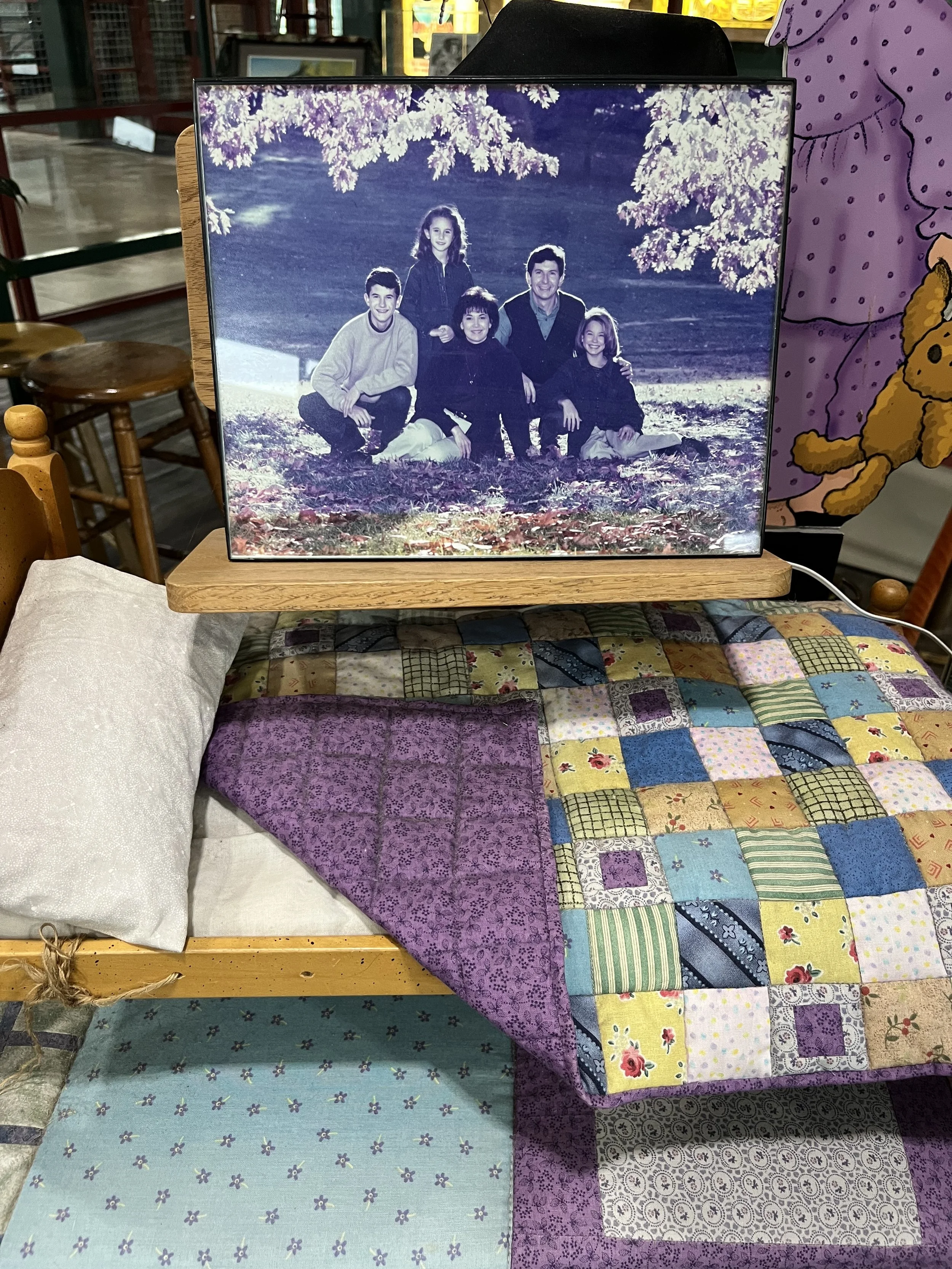
The museum includes several tributes to David Hawley’s brother Greg Hawley, who died in 2009. Photo courtesy of the Jackson County Historical Society.
Today I am looking for someone who can carry the collection forward. I acknowledge that once the collection belongs to somebody else, I won’t have a say in it anymore. So I am being careful about who I want it to go to - people who would share the same interest I have in seeing it remain together as a collection.
Today I look at the collection like a jigsaw puzzle. When you put all the pieces together you have this wonderful tapestry with all its parts and pieces. You could sell parts of it, but it would not look the same. I look at the collection that tells the story of the volume of what was coming west on the steamboats in the 19th century. People tell us what impresses them the most is the volume. They say “I’ve been to a museum and seen old boots before but I’ve never seen hundreds of old boots - or guns, or dishes, or whatever - all at the same time.”
Q. You have dug up two steamboats - the Arabia and Missouri Packet - but you have discovered the location of 10 others. That includes the Malta, which sank in 1841 near what is now Malta Bend, in Saline County, some 95 miles east of Kansas City. Is the Malta a likely candidate for excavation?
A. Yes. The Malta had been headed to St. Joseph when it sank.
Divine intervention
Q. Your father Bob died in 2019 and your mother Florence in 2023. The Arabia hosted visitations for both of them.
A. We had both of them on the Arabia deck, their caskets surrounded by flowers. The museum was a place of life, not death.
Q. Had there been a faith component, or a religious reason, in your family’s decision to risk such an investment of time and resources in an adventure - that later became a business - where the return of investment was unknown?
A. I can’t say we prayed over the idea. But I remember somebody once saying that when you are in the middle of a miracle you don’t realize you are in the middle of a miracle until you are on the other side of the miracle, looking back. The path we picked could not have been any better. And people came to us at just the right time, like when the city called saying “We have a building that is perfect for you.” So, in retrospect, I 100-percent believe that there was some kind of divine intervention. Were we all that smart enough, intuitive enough, on our own? Probably not.